
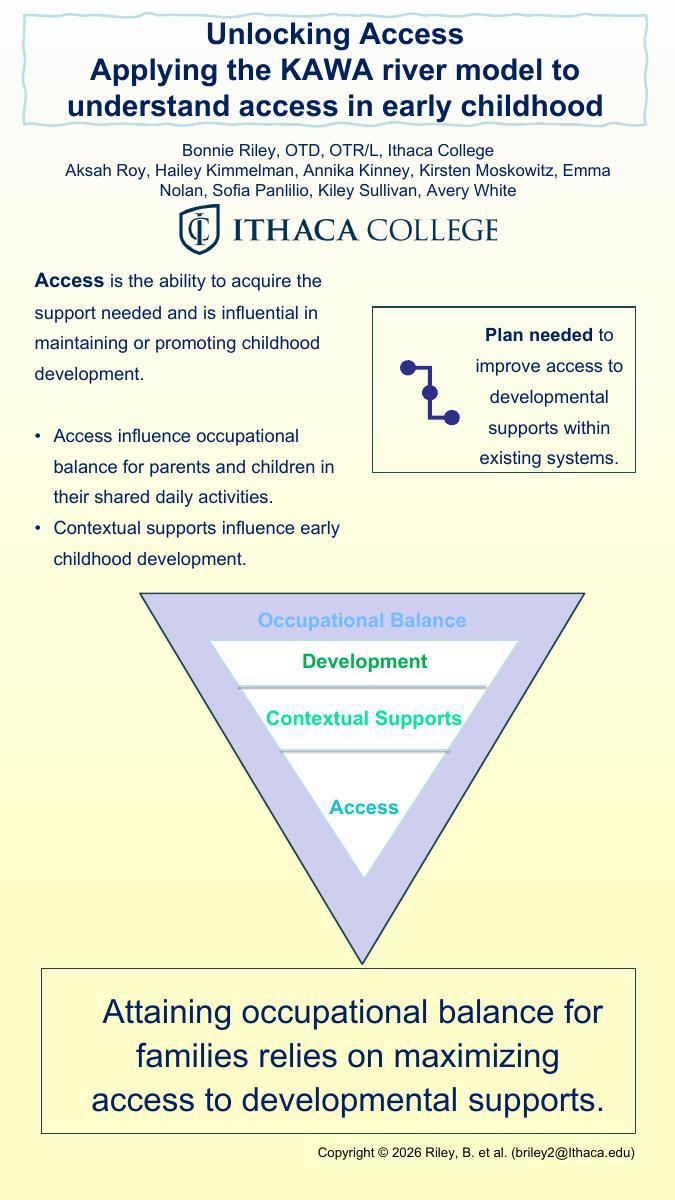
Introduction / Rationale: Contextual supports in early childhood can promote child development. Access, the ability to acquire the support needed, is influential in maintaining or promoting childhood development. Likewise access may also influence occupational balance for parents and children in their shared daily activities. Thus, exploring child and parent access to developmental resources identifies actions to improve developmental supports within existing systems.
Objectives: The application of the KAWA river model conceptually organizes considerations for access to developmental resources and supports in early childhood.
Methods/Approach: A participatory action research (PAR) study was conducted, using the Kawa model to establish the approach for data collected. Interviews were conducted with early childhood professionals (n= 14) and parents (n= 17) completed surveys to share their experiences.
Results / Practice Implications: Key ideas shared by participants align with constructs of the Kawa River model, reinforcing identified supports and barriers for promoting development in early childhood with significance for family occupational balance. Collaboration within inclusive systems is necessary for increasing access for children and their families.
Conclusion / Significance to the Occupational Therapy Profession: Attaining occupational balance for families relies on maximizing access to developmental supports. Understanding access is an opportunity to build professional workforce capacity to respect unique considerations for young children and their families while identifying community actions for health promotion initiatives.