
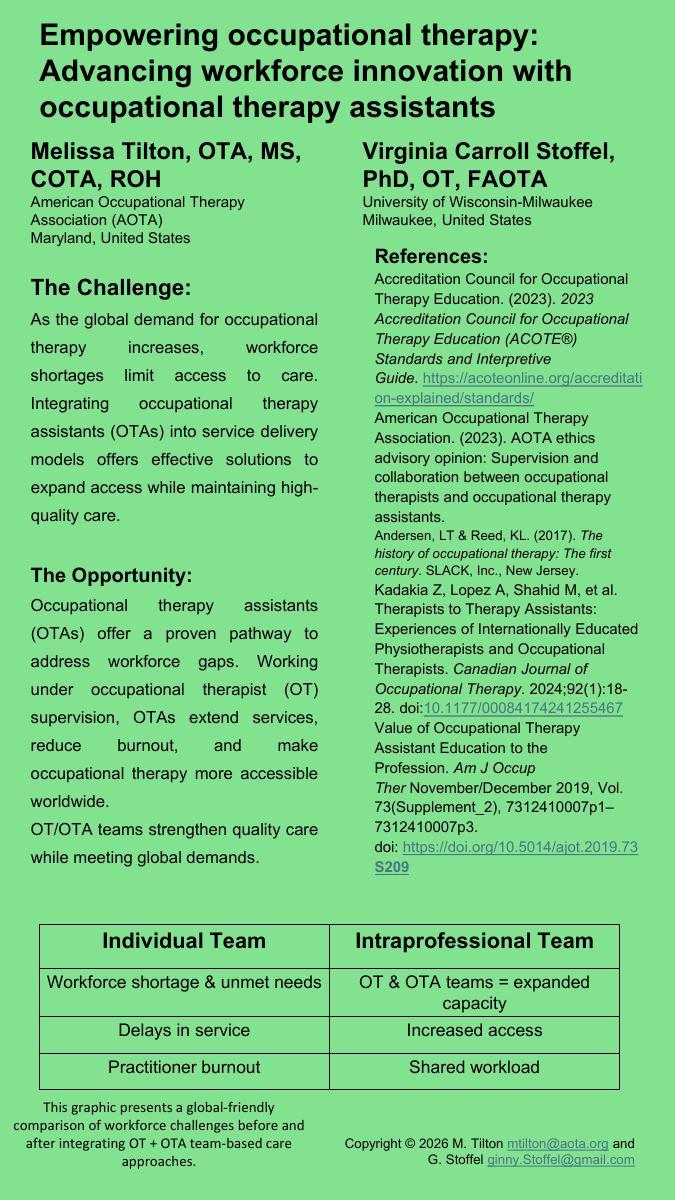
Introduction/Rationale: As the global demand for occupational therapy increases, workforce shortages limit access to care. Integrating occupational therapy assistants (OTAs) into service delivery models offers effective solutions to expand access while maintaining high-quality care.
This presentation explores how OTAs work alongside occupational therapists (OTs) to reduce workforce burdens, extend services to underserved populations, and enhance sustainability of the profession worldwide, a focus of the WFOT.
Objectives: Attendees will gain insights into how OTAs can help alleviate workforce shortages, strengthen service delivery, and ensure more people receive the occupational therapy services they need. Attendees will be exposed to OTA educational standards, collaborative and supervisory strategies, and professional association engagement across OTAs and OTs.
Methods/Approach: Narratives about OTA/OT collaborative practice will be shared, with links to existing documents developed across the past 80 years in the United States. In 1944, during World War II, military hospitals called for an expanded occupational therapy workforce. Formal educational and practice standards for OTAs were later developed in the 1950’s and 60’s.
Results/Practice Implications: International examples of successful OTA integration will highlight strategies for workforce planning, role delineation, and policy development. Insights regarding how OTAs can help alleviate workforce shortages, strengthen service delivery, and ensure more people access occupational therapy worldwide will be shared.
Conclusion: Embracing OTA workforce expansion in a manner that meets each country’s needs can inspire change, increase access, and build a more sustainable future for occupational therapy worldwide.