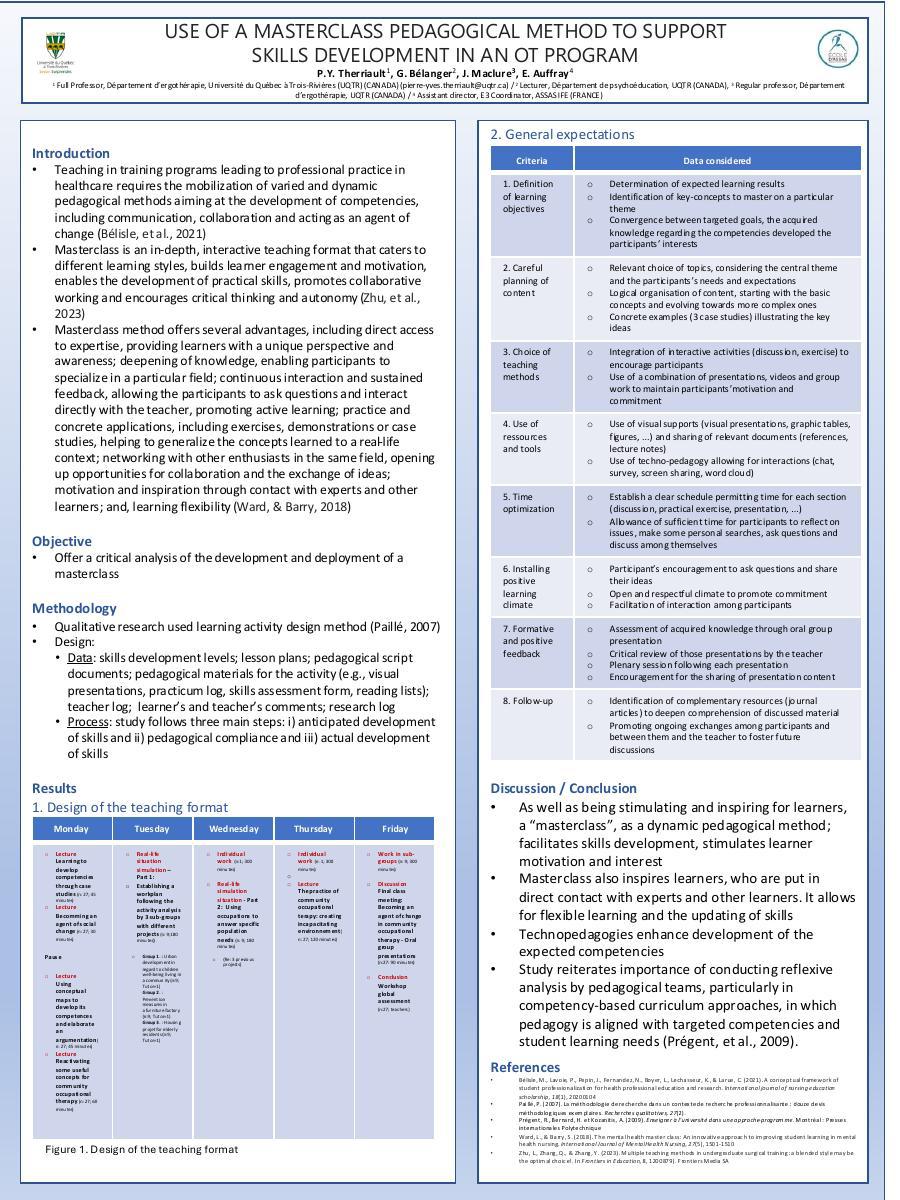
Rationale: Teaching in training programs leading to OT requires the mobilization of varied and dynamic pedagogical methods. To help achieve this, the masterclass method can be used to develop the skills for the practice. The master class as a specific teaching method offers a number of advantages, including direct access to expertise, deepening of knowledge, continuous interaction and sustained feedback, and promoting active learning; practice and application. Including exercises, demonstrations or case studies, the method help to generalize the concepts learned to a real-life context; networking with other enthusiasts in the same field, opening up opportunities for collaboration and the exchange of ideas. Pedagogically, how is a master class structured and deployed? What are the requirements for learners and teachers?
Objective: The aim of this presentation is to offer a critical analysis of the development and deployment of a masterclass.
Methods: To answer these questions, a learning activity design method was used. This enabled to collect and analyze the necessary data in a precise and rigorous manner.
Results: The organization and articulation of the various pedagogical activities, as well as the teaching styles advocated, are detailed and critiqued. The links between teaching methods and activities are presented and discussed. The requirements for learners and teachers are also identified.
Conclusion: The masterclass provides inspiration for learners, who are put in direct contact with experts and other learners. It allows for flexible learning and the updating of skills.
