
Introduction / Rationale: Occupational science scholars have been “called in” to critically examine their conceptualizations and theorizations of occupation by engaging epistemological questions related to knowledge production, appraising conventional methodologies, and mobilizing existing knowledge for political practice within occupational therapy (e.g., Farias & Laliberte Rudman, 2019; Ramugondo, 2024; Wijekoon & Peter, 2022). The discipline has also been charged to employ decolonizing methodologies that illuminate the nuances of occupation and democratize research processes for multiply marginalized communities (Emery-Whittington, 2021; Johnson & Lavalley, 2021). In parallel, occupational science scholars must also rethink the onto-epistemic positioning of whiteness and whiteness ideologies predominant in the field (Kronenberg, 2021; Parkin & Johnson, 2024).
Objective: We propose that critical participatory action research (PAR) is an appropriate approach as it is antithetical to whiteness, creates the conditions to name, frame, and transform contextual factors that cause harm, and develops forms of emancipatory actions that meet the occupational needs of multiply marginalized communities.
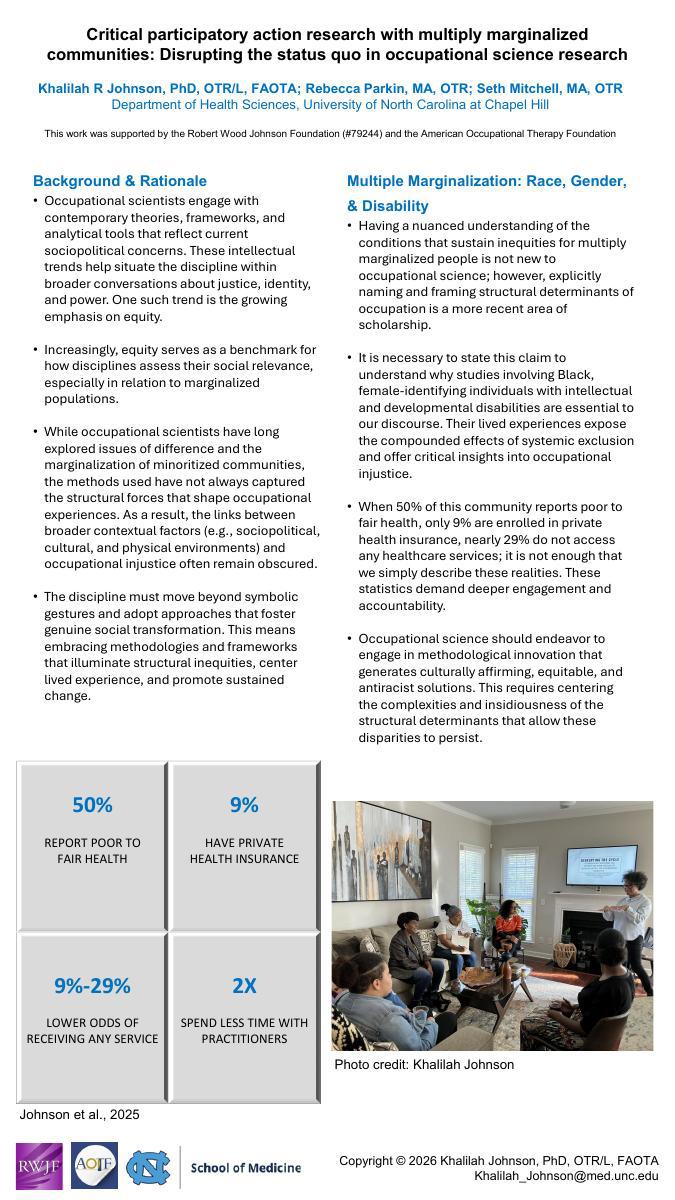
Methods / Approach: Using examples from a research study with Black people with intellectual and developmental disabilities (IDD) and their care partners, we will demonstrate how critical PAR offers scholars a framework to disrupt colonial legacies of whiteness impacting research processes and better theorize about occupation from the perspectives of Black people with IDD (Johnson et al., 2025; Tuhiwai Smith, 1999). We will also describe the critical PAR process, challenges to implementing critical PAR methods, and collaborative strategies to overcome pitfalls.
Implications: Grounded in these insights, we contend that decolonized occupational science requires more targeted naming and framing the politics, problems, and practices of the discipline.