
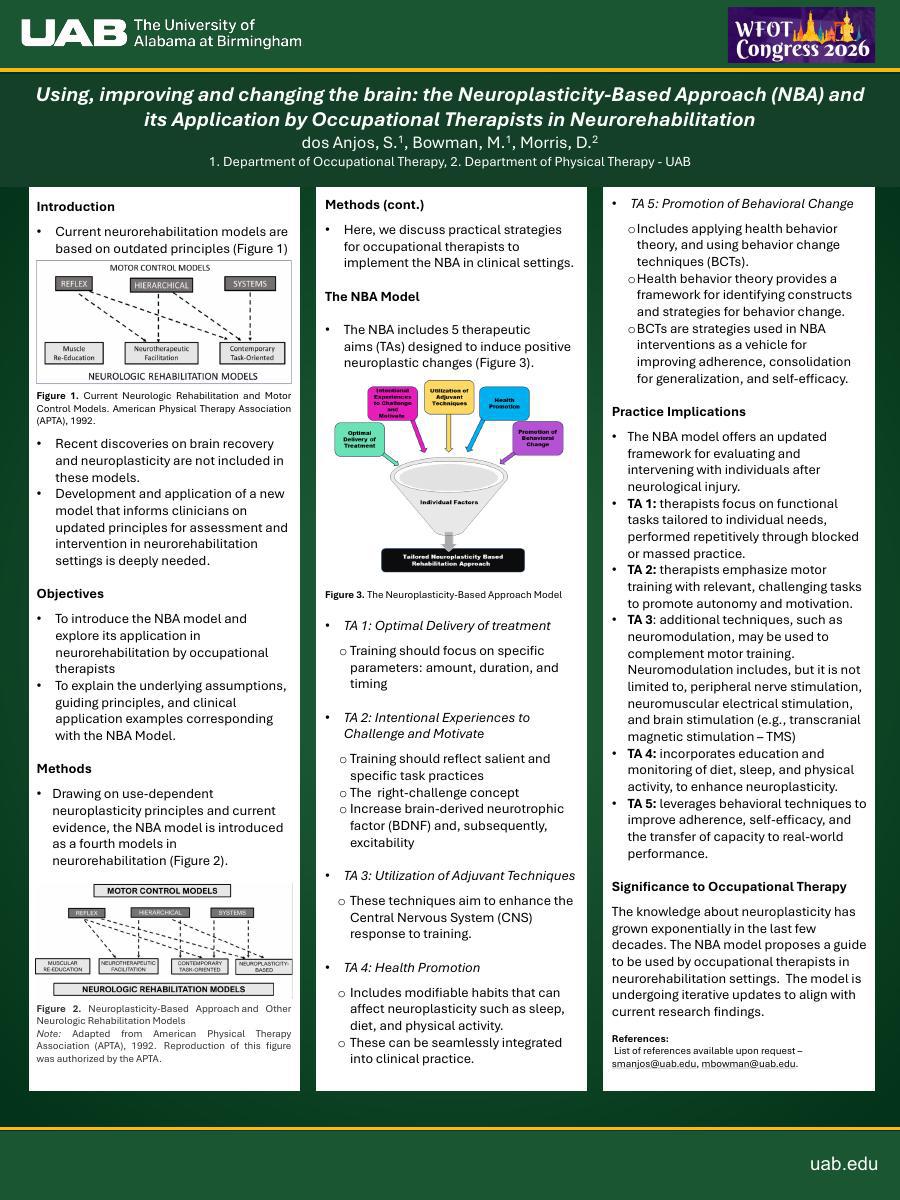
Introduction: Neurorehabilitation models currently used by occupational therapists for both assessment and intervention of individuals with neurological conditions follow assumptions aligned with the Reflex, Hierarchical and Systems Models of Motor Control and Recovery. These models do not follow recent scientific discoveries regarding neuroplasticity. Therefore, the Neuroplasticity-based Approach (NBA) was developed including 5 therapeutic aims: 1) optimal delivery of treatment, 2) intentional experiences to challenge and motivate, 3) use of adjuvant techniques, 4) health promotion, and 5) promotion of behavioral change.
Objectives: To introduce the NBA model and explores its application in neurorehabilitation by occupational therapists; to explain the underlying assumptions, guiding principles, and clinical application examples corresponding with the NBA Model.
Methods: Drawing on use-dependent neuroplasticity principles and current evidence, the NBA model proposes five therapeutic aims (TAs) designed to induce positive neuroplastic changes. We discuss practical strategies for occupational therapists to implement these aims in clinical settings.
Practice Implications: The NBA model offers an updated, framework for evaluating and intervening with individuals after neurological injury. On TA one, therapists focus on functional tasks tailored to individual needs, performed repetitively through blocked or massed practice. TA two emphasizes motor training with relevant, challenging tasks to promote autonomy and motivation. On TA three, additional techniques such as neuromodulation may complement motor training. TA four incorporates health promotion strategies—addressing diet, sleep, and physical activity—to enhance neuroplasticity. TA 5 leverages behavioral techniques to improve adherence, self-efficacy, and the transfer of capacity to real-world performance.
Significance to Occupational Therapy Profession: The knowledge about neuroplasticity has grown exponentially in the last few decades. The NBA model propose a guide to be used by occupational therapists in neurorehabilitation settings.