
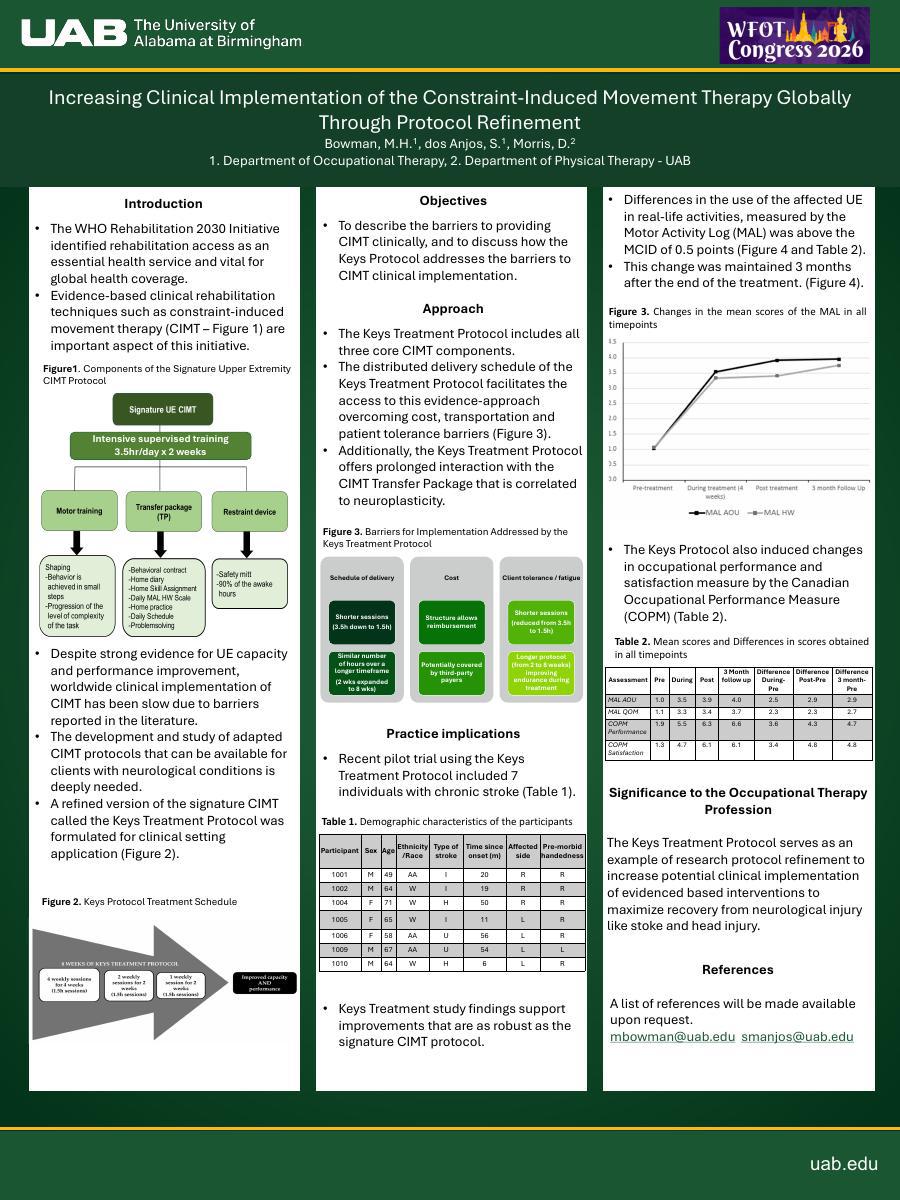
Introduction: The World Health Organization outlined the Rehabilitation 2030 Initiative identifying rehabilitation access as a vital health service for universal health coverage. Interventions with strong evidence on improving capacity and performance will be essential to support this initiative. One of these interventions is Constraint-Induced Movement Therapy (CIMT), however, its implementation has been slow due to limited therapist resources, scheduling challenges, and lack of reimbursement. A refined version of the signature CIMT called the Keys Treatment Protocol was formulated for clinical setting application.
Objectives: To describe the barriers to providing CIMT clinically, and to discuss how the Keys Protocol addresses the barriers to CIMT clinical implementation.
Approach: CIMT addresses learned nonuse of the affected upper extremity (UE) using three core components provided over 10 consecutive weekdays for 3.5 hours daily. In the Keys Treatment Protocol, all three CIMT components are present. Keys Treatment, delivered in a distributed fashion, tapers over an 8-week period, offering a prolonged interaction with the CIMT Transfer Package that is correlated to neuroplasticity.
Practice Implications: The Keys Protocol has shown similar results to the signature CIMT while applying all of its elements. Most importantly, the Keys protocol promotes significant changes in capacity and performance of individuals with neurological conditions in a delivery method that could potentially being implemented broadly in clinical settings. The Keys protocol provides a more flexible schedule, shorter sessions, and overall extended interaction with the elements of the protocol, which would follow other treatment protocols that currently match third-party payers requirements.
Conclusion: The Keys Protocol serves as a potentially reimbursable CIMT protocol refinement to increase potential clinical implementation of of an evidenced based intervention with individuals with neurological injuries.