
Introduction: Occupational science was introduced to Japan in 1995 through a workshop by American researchers. The Japanese Society for the Study of Occupation was established in 2006. and continues to publish a journal and hold annual meetings.
Objectives: This study aims to explore how the Japanese Journal of Occupational Science authors have positioned occupational science over the early 15 years from 2006 to 2020.
Methods: The discourses of 14 authors of the preface, 14 speakers of the Tsuyoshi Sato Memorial Lecture, and 4 authors of the 10th-anniversary column published in the journal between 2006 and 2020 were analyzed in terms of how occupational science has been positioned.
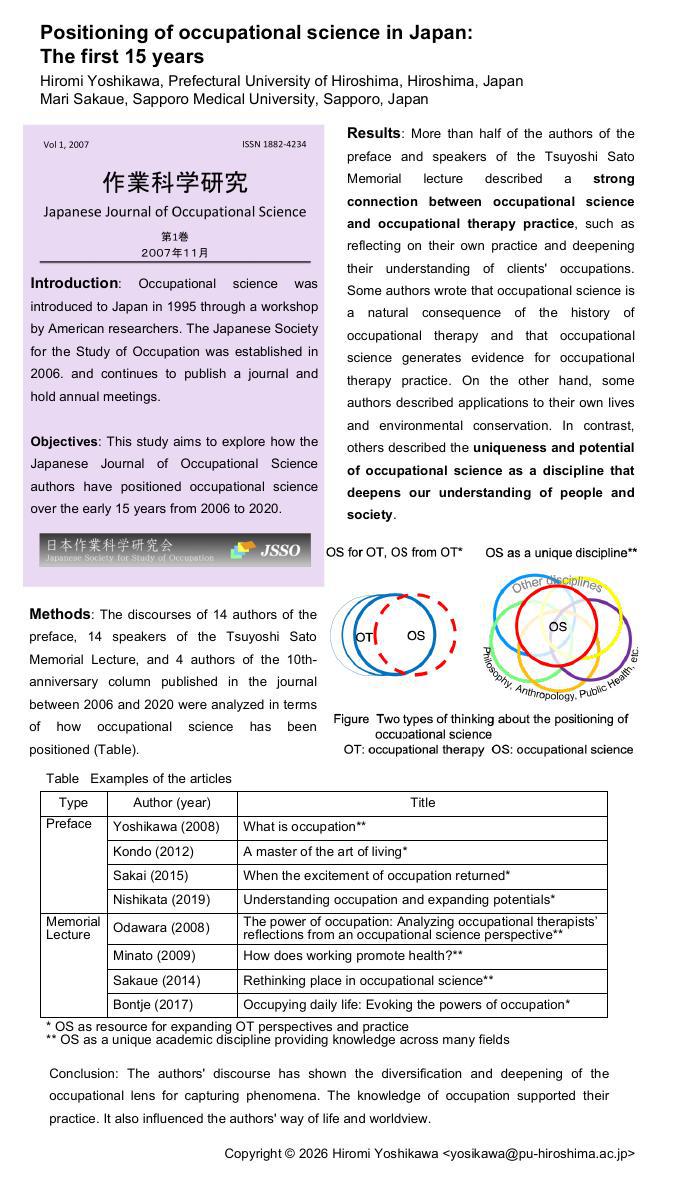
Results: More than half of the authors of the preface and speakers of the Tsuyoshi Sato Memorial lecture described a strong connection between occupational science and occupational therapy practice, such as reflecting on their own practice and deepening their understanding of clients' occupations. Some authors wrote that occupational science is a natural consequence of the history of occupational therapy and that occupational science generates evidence for occupational therapy practice. On the other hand, some authors described applications to their own lives and environmental conservation. In contrast, others described the uniqueness and potential of occupational science as a discipline that deepens our understanding of people and society.
Conclusion: The authors' discourse has shown the diversification and deepening of the occupational lens for capturing phenomena. The knowledge of occupation supported their practice. It also influenced the authors' way of life and worldview.