
Introduction/Rationale: Artificial intelligence (AI) is transforming how students learn, how clients access information, and how occupational therapists develop intervention plans and document treatment (Rasa & Borja, 2024). Faculty must not only become comfortable with AI but also be able to teach their students how to use it effectively in clinical practice.
Objectives: The primary objectives of this initiative were to:
- Increase the understanding of AI among OT faculty.
- Enhance the comfort level of faculty in using AI tools.
- Develop strategies for integrating AI into the OT curriculum.
- Ensure that faculty can effectively teach AI-related skills to OT students.
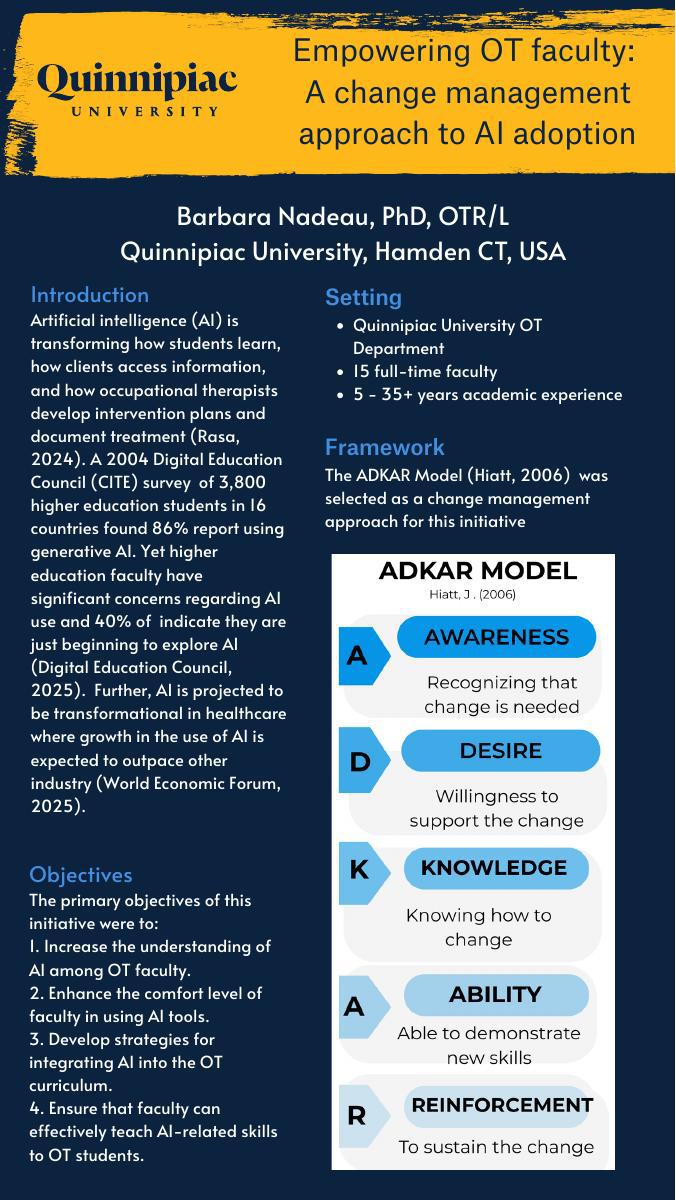
Methods/Approach: To guide the faculty in adopting AI, Prosci's ADKAR model of change management was utilized. This model includes five stages: Awareness, Desire, Knowledge, Ability, and Reinforcement (Creasey, 2018).
The ADKAR model provided a structure to reduce resistance and build faculty confidence in using AI.
Results/Practice Implications: The use of a change management approach led to an increase in faculty confidence and competence in using AI tools. Faculty reported feeling more comfortable integrating AI into their teaching. The initiative also fostered a culture of continuous learning and adaptation among the faculty.
Conclusion/Contribution to the occupational therapy profession: It is critical that new clinicians enter the profession with proficiency in AI and the ability to advocate for the value of OT in this evolving landscape. By using change management strategies educational programs can facilitate the effective integration of AI, ensuring that faculty and students are prepared for the future of OT practice.