
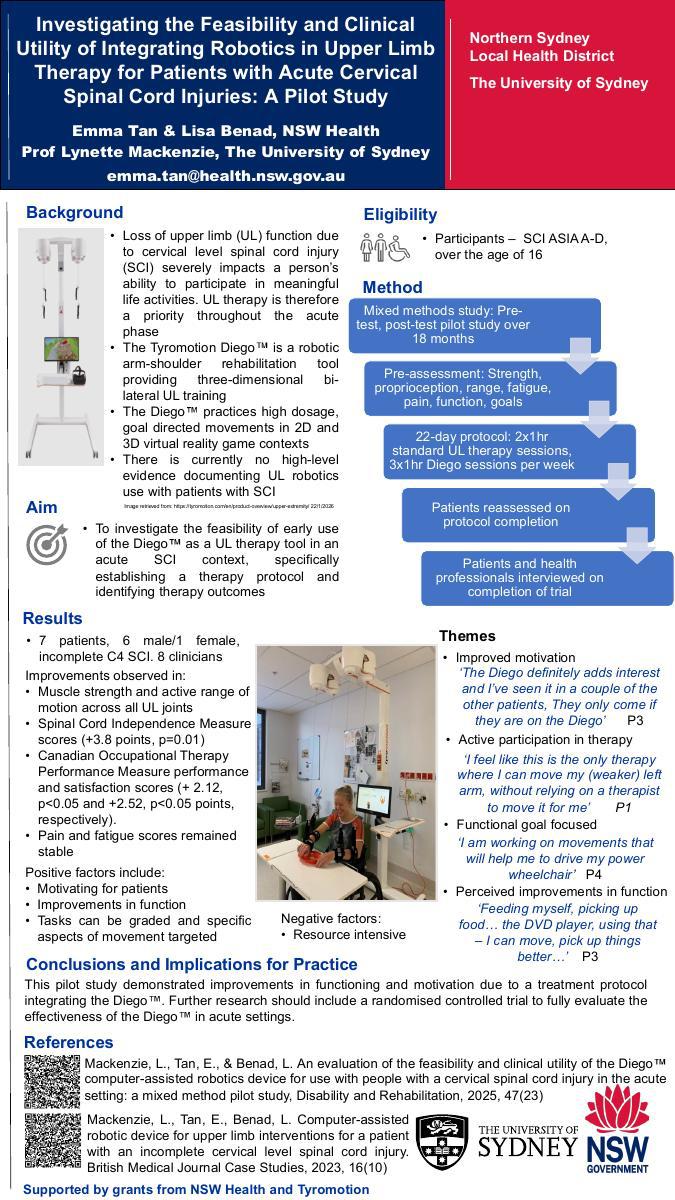
Introduction: Loss of upper limb (UL) function due to cervical level spinal cord injury (SCI) severely impacts a person’s ability to participate in meaningful life activities. UL therapy is, therefore, a priority throughout the acute phase.
The Tyromotion Diego™ is a robotic arm-shoulder rehabilitation tool providing three-dimensional bi-lateral UL training.
There is currently no high-level evidence documenting UL robotics use for patients with cervical SCI.
Objective: To investigate the feasibility of early use of the Diego™ as a UL therapy tool in an acute SCI context, specifically establishing a therapy protocol and identifying therapy outcomes.
Methods: A mixed methods study including prospective measurement of outcomes and qualitative interviews with participants and health professionals. A 22-day program was implemented incorporating 2 x 1-hour standard UL sessions per week and 3 x 1-hour Diego™ sessions per week. Participants were assessed on recruitment and at the completion of the program.
Results: Seven patients (6 male, 1 female) and 8 clinicians participated in the study.
Improvements were observed in muscle strength and active range of motion across all UL joints, Spinal Cord Independence Measure scores (+3.8 points, p=0.01) and Canadian Occupational Therapy Performance Measure performance and satisfaction scores (+ 2.12, p=0.028 and +2.52, p=0.028 points respectively). Pain and fatigue scores remained stable. Qualitative findings indicated that despite small functional gains, patients experienced psychological benefits in hope, engagement in therapy, and motivation.
Conclusion: This pilot study demonstrated improvements in functioning and motivation due to a treatment protocol integrating the Diego™. Further research should include a randomised controlled trial to fully evaluate the effectiveness of the Diego™ in acute settings for patients with cervical SCI.