
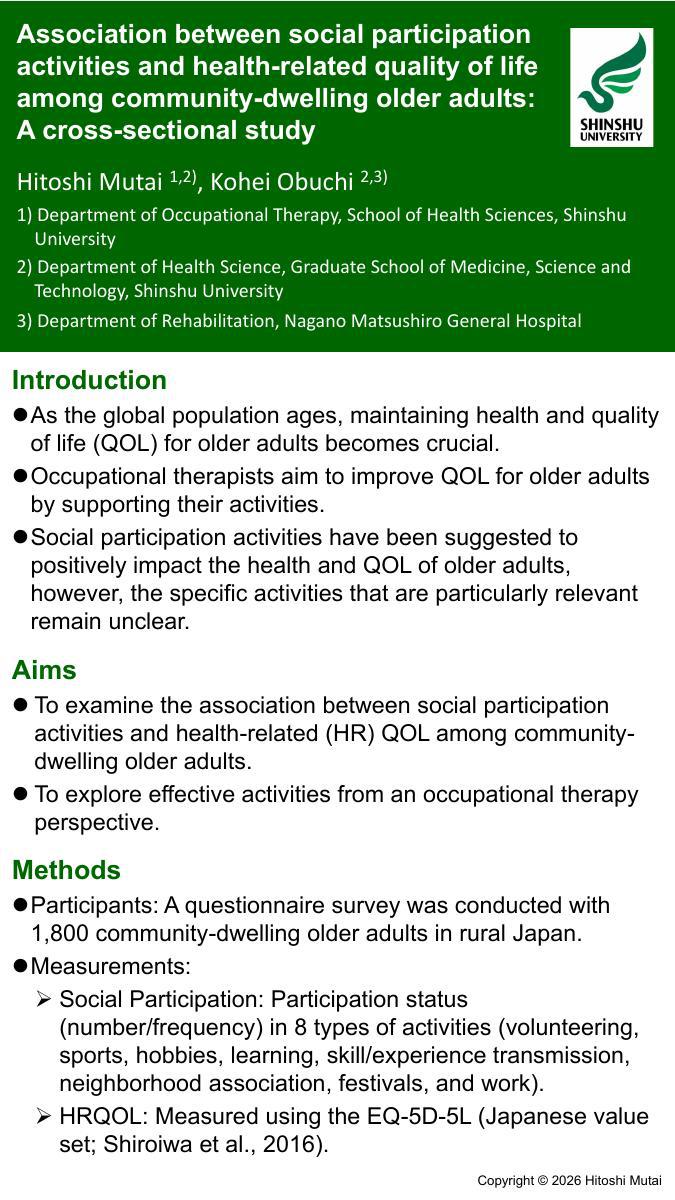
Introduction: As the global population ages, maintaining health and quality of life (QOL) for older adults becomes crucial. Occupational therapists aim to improve QOL for older adults by supporting their activities. Social participation activities have been suggested to positively impact the health and QOL of older adults, however, the specific activities that are particularly relevant remain unclear.
Objectives: This study aims to examine the association between social participation activities and health-related (HR) QOL among community-dwelling older adults, and to explore effective activities from an occupational therapy perspective.
Methods: A survey of 1,800 community-dwelling older adults assessed participation in eight social activities (volunteering, sports, hobbies, learning, skill/experience transmission, neighborhood association, festivals, and work) and HRQOL using EQ-5D-5L. Analysis of covariance, adjusted for age and sex, examined associations between activities and EQ-5D-5L scores. Spearman's rank correlation coefficient analyzed relationships between participation frequency and number of activities participated in, and EQ-5D-5L scores. This study was approved by the Ethics Review Committee.
Results: Work (38.4%) and hobbies (35.6%) had high participation rates, while skill/experience transmission (10.2%) and learning (24.0%) had low. 76.4% participated in at least one activity. Participants showed significantly higher EQ-5D-5L scores for all activities than non-participants, with work, festivals, and sports having larger effect sizes. Weak positive correlations were found between EQ-5D-5L scores and participation frequency and number of activities.
Conclusion: Results suggest that diverse social activities positively impact older adults' HRQOL. Especially work contributes to maintaining living standards and may improve HRQOL. Occupational therapists should promote health through community-based and meaningful activities, while evaluating activity quality and providing individualized support.