
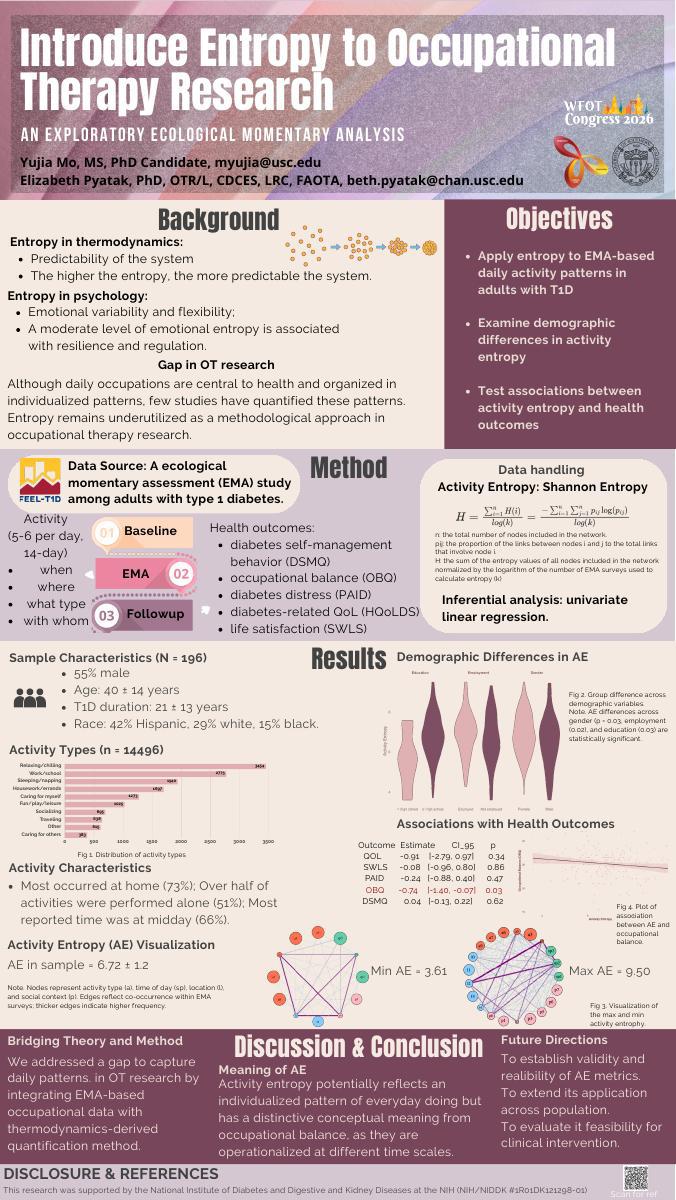
Introduction: Entropy, originally rooted in thermodynamics to reflect unpredictability, has been applied across fields to capture patterns and dynamics. Psychology research identifies it as a negative factor triggering non-adaptive behaviors. Daily occupations as a component in human life, containing individualized patterns and health impacts, have yet to be investigated by entropy.
Objectives: To apply entropy to EMA activity data collected from individuals with type 1 diabetes (T1D) and to investigate the relationships between activity entropy, demographic factors, and health outcomes.
Methods: Data were from FEEL-T1D, a longitudinal EMA study in which participants completed 5-6 surveys/day for 10-14 days. In each survey, participants reported their current activity, including time, activity type, location, and social context. Health outcomes included diabetes self-management behavior (DSMQ), diabetes distress (PAID), and occupational balance (OBQ). We incorporated the co-occurrence of activity characteristics within each survey as activity entropy (AE); a greater variety of combinations indicates higher AE, reflecting more unpredictable patterns of daily occupations. Associations with health outcomes and demographics were examined by univariate linear regression.
Results: 196 participants (aged 39.5 +/- 14.3 years; 54.6% male) completed 144976 surveys. Higher AE significantly predicted lower PAID (std.est = -0.16, p = 0.02) and was marginally associated with increased DSMQ (std.est = 0.13, p = 0.06); no relationship emerged with OBQ. Males, individuals without a partner, the unemployed, and those with less than high school education exhibited significantly lower AE (p <0.05).
Conclusion: Our findings suggest that a diverse and flexible daily activity pattern may benefit individuals with chronic conditions, offering a novel perspective that challenges traditional views of entropy. This approach opens new avenues for research and practice in OT.