
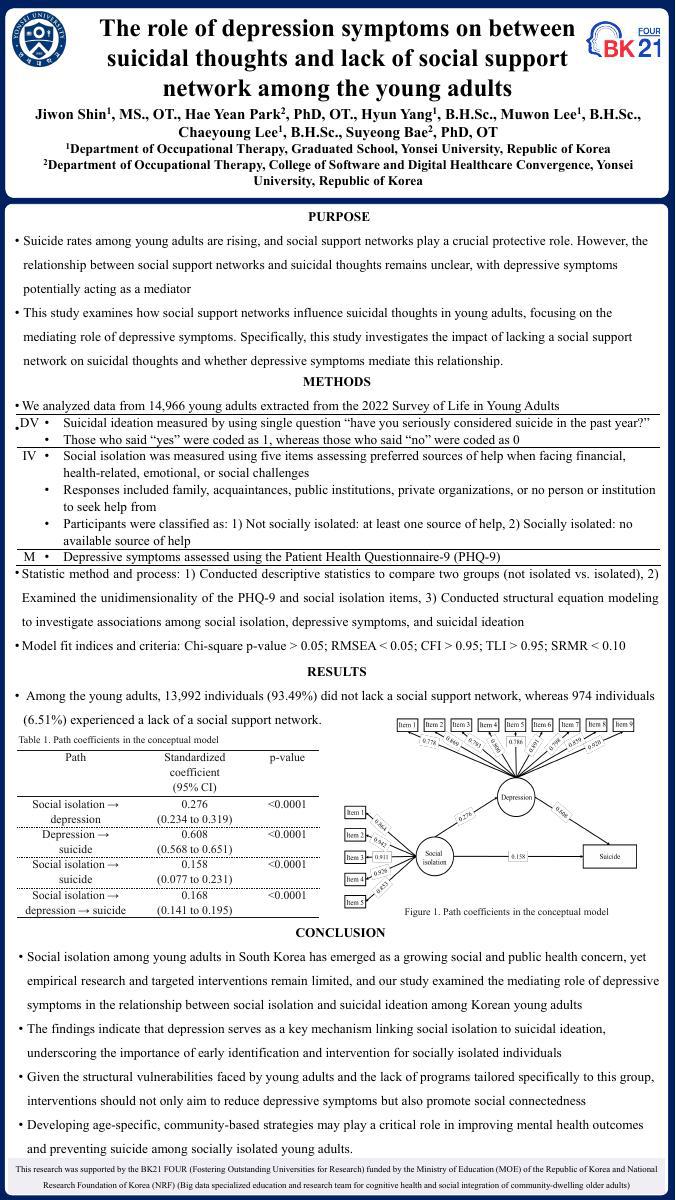
Introduction / Rationale: Suicide rates among young adults are rising, and social support networks play a crucial protective role. However, their relationship with suicidal thoughts remains unclear, with depression symptoms potentially acting as a mediator. This study examines how social support networks influence suicidal thoughts in young adults, focusing on the mediating role of depression symptoms.
Objectives: To investigate the impact of lacking a social support network on suicidal thoughts and whether depression symptoms mediate this relationship.
Methods / Approach: We analyzed data from 14,966 young adults extracted from the 2022 Survey of Life in Young Adults. The dependent variable was suicidal thoughts, assessed through a single question. The independent variable was lack of a social support network, and the mediator was depression symptoms. We utilized structural equation modeling to examine the mediating effect of depression symptoms on the relationship between lack of a social support network and suicidal thoughts.
Results / Practice Implications: Among the young adults, 13,992 individuals (93.49%) did not lack a social support network, while 974 individuals (6.51%) experienced a lack of a social support network. Significant associations were found between lack of a social support network and suicidal thoughts, lack of a social support network and depressive symptoms, and depressive symptoms and suicidal thoughts (all p < .001). In our model, 51.53% of the variance was explained by indirect effects, while 48.47% was attributed to direct effects.
Conclusion / Significance to the occupational therapy profession: Our findings highlight the role of depression symptoms in the link between social support networks and suicidal thoughts, emphasizing the need to strengthen social support in suicide prevention.