
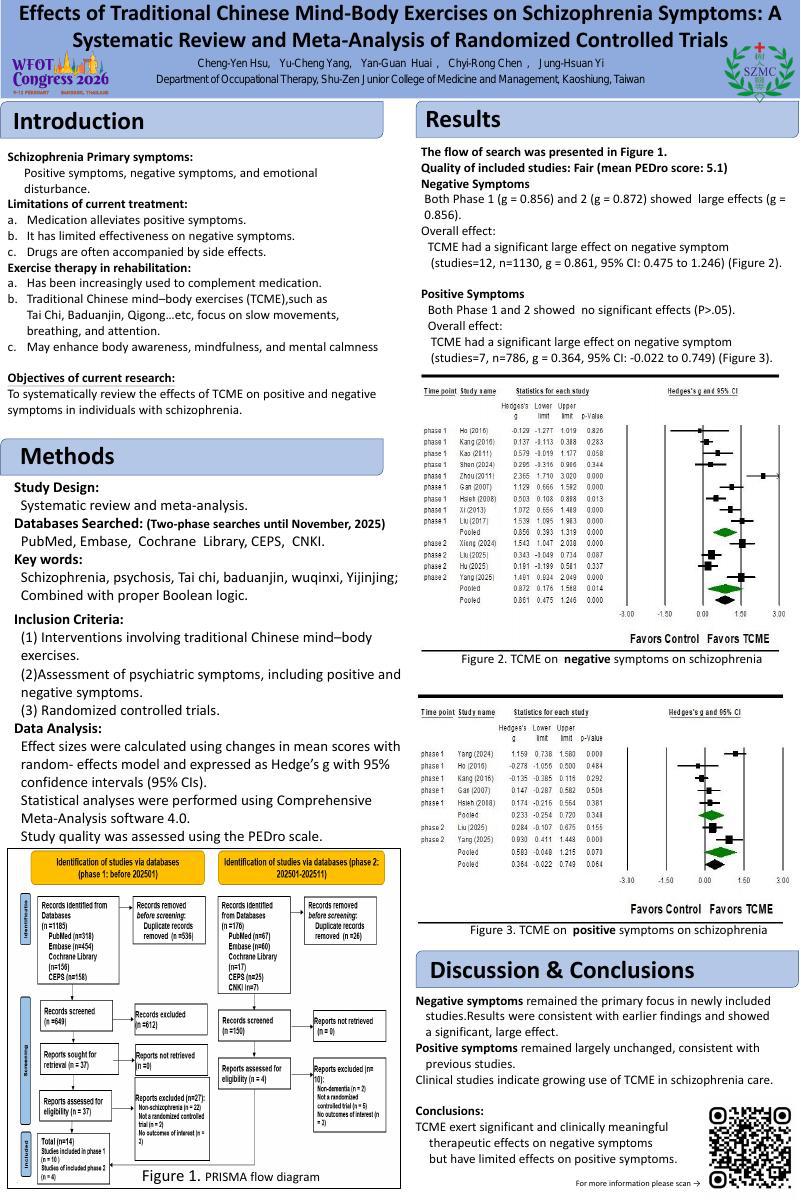
Introduction: Schizophrenia is characterized by positive symptoms (e.g., delusions, hallucinations) and negative symptoms (e.g., amotivation, social withdrawal). Exercise therapy has been increasingly applied in schizophrenia rehabilitation. Traditional Chinese mind-body exercises, such as Tai Chi, Baduanjin, and Qigong, emphasize coordinated movement and breathing, potentially facilitating mindfulness and stabilizing psychiatric symptoms. However, their effectiveness remains inconclusive.
Objective: To systematically review the effects of traditional Chinese mind-body exercises on positive and negative symptoms in individuals with schizophrenia.
Methods: This study will be a two-phase systematic review and meta-analysis approach. The first literature search covers studies published before January 2025, while an updated search will be conducted in November 2025. Two independent researchers will search PubMed, Embase, Cochrane Library, CEPS, and CNKI. Inclusion criteria: (1) randomized controlled trials (RCTs) involving individuals with schizophrenia, (2) interventions incorporating traditional Chinese mind-body exercises, and (3) assessments of psychiatric symptoms, including positive and negative symptoms. Effect sizes are calculated using Hedge’s g, and study quality is evaluated using the PEDro scale.
Results: A total of 10 RCTs have been included, with an overall study quality ranging from fair to good. Preliminary findings indicate no significant effect on positive symptoms (N=5, n=624, Hedge’s g = 0.235, p = 0.348), while a strong effect was observed for negative symptoms (N=9, n=868, Hedge’s g = 0.865, p < 0.001).
Conclusion: These findings support the therapeutic potential of traditional Chinese exercises in alleviating negative symptoms of schizophrenia. Future studies should explore their impact on cognitive and physical functioning.