
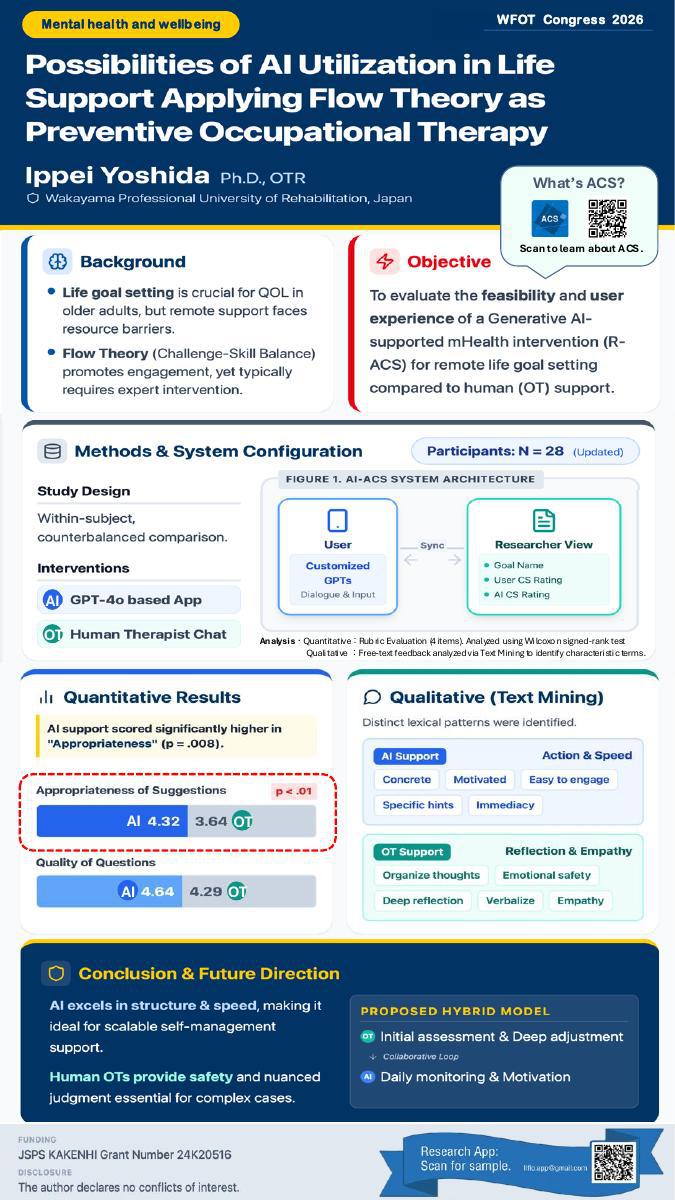
Introduction:Decreased motivation is a major barrier to activity continuation in elderly life support. Flow Theory, a concept in positive psychology, describes a mental state of deep engagement and fulfillment, facilitated by a balance between challenge and skill (Challenge-Skill Balance: CS Balance). While widely studied in sports and the arts, its application to daily life support remains limited. The principal investigator developed Adjusting the Challenge-Skill Balance (ACS) in rehabilitation, showing its potential to enhance QOL. A preventive remote life support program is now planned, but conventional occupational therapy processes (e.g., assessment, trust-building, individualized planning) are challenging in remote settings. AI-driven ACS support may address these challenges.
Objective:This study examines whether generative AI can enhance remote life goal support and contribute to a practical support model.
Methods:Six participants (two per age group: 10s–20s, 30s–40s, 50s–60s) set two life goals. Challenge and skill levels were assessed using a 7-point Likert scale. Participants received ACS-based support from an occupational therapist (OT support) and AI (AI support), in a randomized crossover design. AI support used a GPT-based program. Support was evaluated using rubrics, comparing assessment discrepancies and time efficiency.
Contribution to the occupational therapy profession:AI support outperformed OT support in response speed, question quality, and overall effectiveness. It promoted autonomy and continuous engagement. Given the private nature of life support, AI-integrated ACS support may reduce psychological burden. Future research will explore hybrid AI-OT support models.