
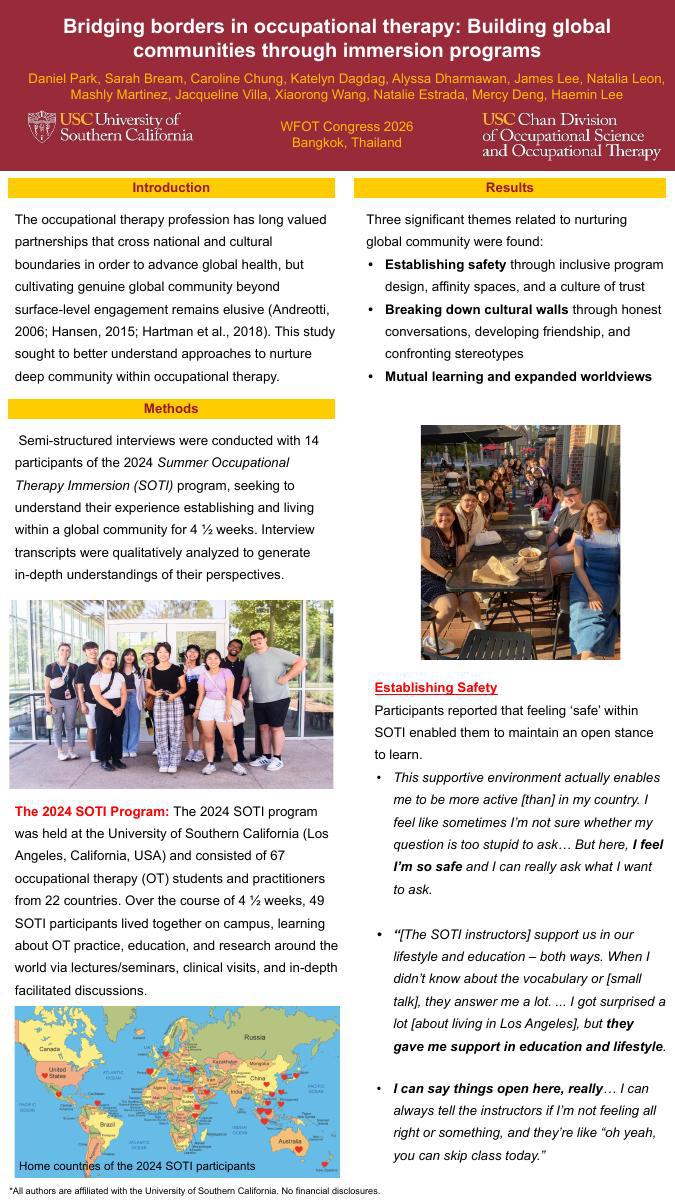
Introduction/Rationale: The occupational therapy profession has increasingly valued partnerships that cross national and cultural boundaries in order to advance global health, but cultivating genuine global community beyond surface-level engagement remains elusive. In order to maximize the impact of our global collaborations, we must better understand approaches to nurturing deep community amongst diverse students and practitioners.
Objectives: This study captured the perspectives of participants in a large international summer occupational therapy immersion program, regarding their experiences in creating and protecting a global community. Participants were OT students and practitioners from 22 countries. This presentation will share narrative data specific to nurturing community/connectedness across diverse populations.
Methods/Approach: Semi-structured interviews were conducted with 14 participants of an international summer immersion program held at a globally-diverse university in the United States. Interview transcripts were qualitatively analyzed to generate deep understandings of perspectives.
Results/Practice Implications: Three significant themes related to nurturing global community were found:
- “Establishing safety” through affinity spaces, inclusive program design, and a culture of trust
- “Breaking down cultural walls” through honest conversations, developing friendship, and confronting stereotypes
- Mutual learning and expanded worldviews
Results also reveal powerful benefits of genuine global community for personal and professional transformation.
Conclusion/Contribution to the Occupational Therapy Profession: Nurturing global community beyond surface-level communications requires thoughtful investment at programmatic and interpersonal levels, with vigilance towards maintaining safety, lowering cultural barriers, and bidirectional learning/listening. Successful global communities will result in a more interconnected OT profession able to responsively address the complex transnational health issues we collectively face.