
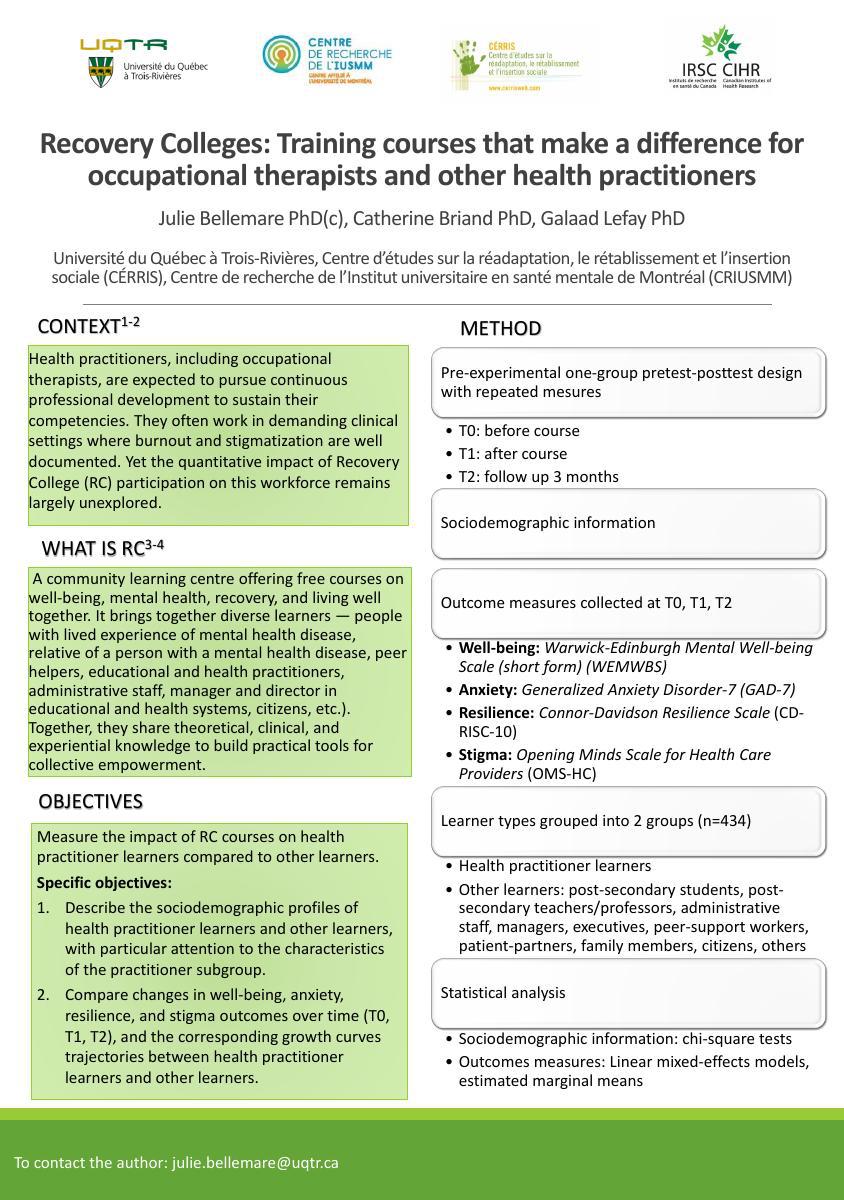
Introduction/Rationale: Occupational therapists and other health practitioners need to engage in continuing professional development to maintain their competencies. Recovery Colleges (RC) offer a unique training model that brings together diverse learners (patients, relatives, practitioners, citizens), fostering co-created knowledge. These co-learning spaces encourage self-care, open-mindedness, and reflection on practices, which is particularly beneficial for health practitioners in stressful environments prone to burnout and stigmatization. However, quantitative measurement of the impact on health practitioners remains underexplored.
Objective: Measuring the impact of a RC courses on health practitioner learners compared to other learners.
Methods: This study used a pre-experimental repeated measures design. Measures of well-being, anxiety, resilience and open-mindedness were taken before, after and three months later the courses for all learners. A linear mixed model was used to compare the two groups of learners.
Results: All learners reported significant improvements in well-being, anxiety, resilience and disclosure/help-seeking. Health practitioner learners were distinguished from other learners by higher scores overall on well-being and resilience, as well as lower scores overall on anxiety, social distance and attitude toward people living with mental illness. No distinction was observed in terms of disclosure/help-seeking.
Conclusion/Contribution to the occupational therapy profession: Despite the distinct scores on well-being, anxiety, resilience, social distance and attitude towards people living with mental illness, health practitioner learners benefit from RC. The RC model of co-learning enables health practitioners to improve their capacity for self-care and resilience, as well as their ability to seek help. Further studies are needed to measure the effects on practice.