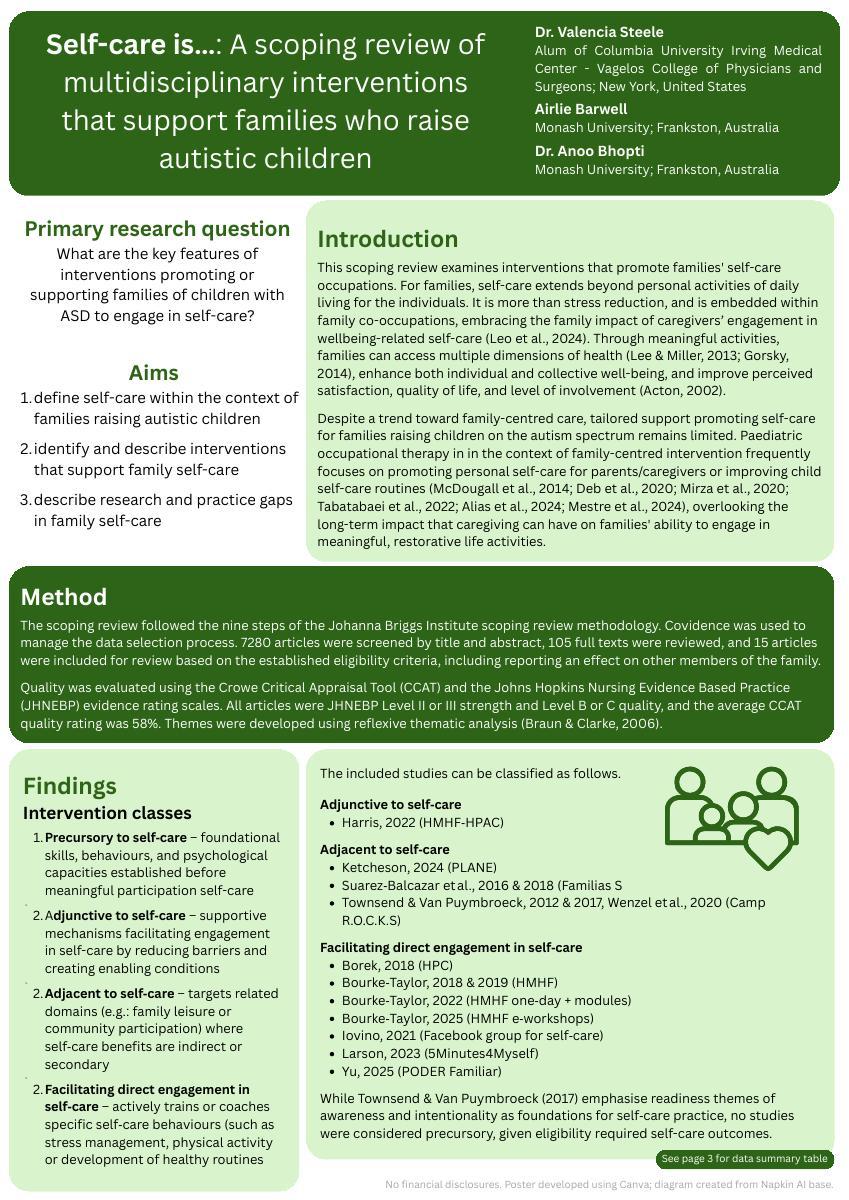
Introduction / Rationale: Pediatric and school-based occupational therapy often prioritizes children, leaving family needs as secondary. Despite a trend toward family-centered care, tailored support for families' self-care – particularly those raising children on the autism spectrum – remains limited. This scoping review examines self-care interventions that promote families' self-care occupations.
Objectives:
1) Define self-care within the context of families raising autistic children; 2) Identify and categorize interventions that support family self-care, and 3) examine research and practice gaps in family self-care.
Methods / Approach: Following systematic literature searching, 2,133 abstracts were screened and following full-text analysis, 73 studies were excluded. Data from 20 studies were extracted using the Crowe Critical Appraisal Tool (CCAT), with research quality assessed via the John Hopkins Rating and analysis performed using frequency statistics and descriptive qualitative content analysis.
Results / Practice Implications: There is currently low to moderate evidence about the effectiveness of self-care interventions for families. Variability in multidisciplinary interventions, the absence of a unified theoretical framework, and ambiguity in defining wellness and health contribute to this gap. The term 'self-care' was rarely used across studies, highlighting a need for clearer conceptualization and stronger empirical support.
Conclusion / Contribution to the occupational therapy profession: Common themes in interventions promoting family self-care are emerging. Empowering families of autistic children through targeted self-care interventions is essential to whole family well-being. Clearly defining the role of family self-care in occupational therapy will enable the holistic health of families of autistic children. Establishing a solid theoretical foundation to guide evidence-based interventions will improve caregiver wellness, while contributing to optimal long-term outcomes for neurodiverse children and their families.
