
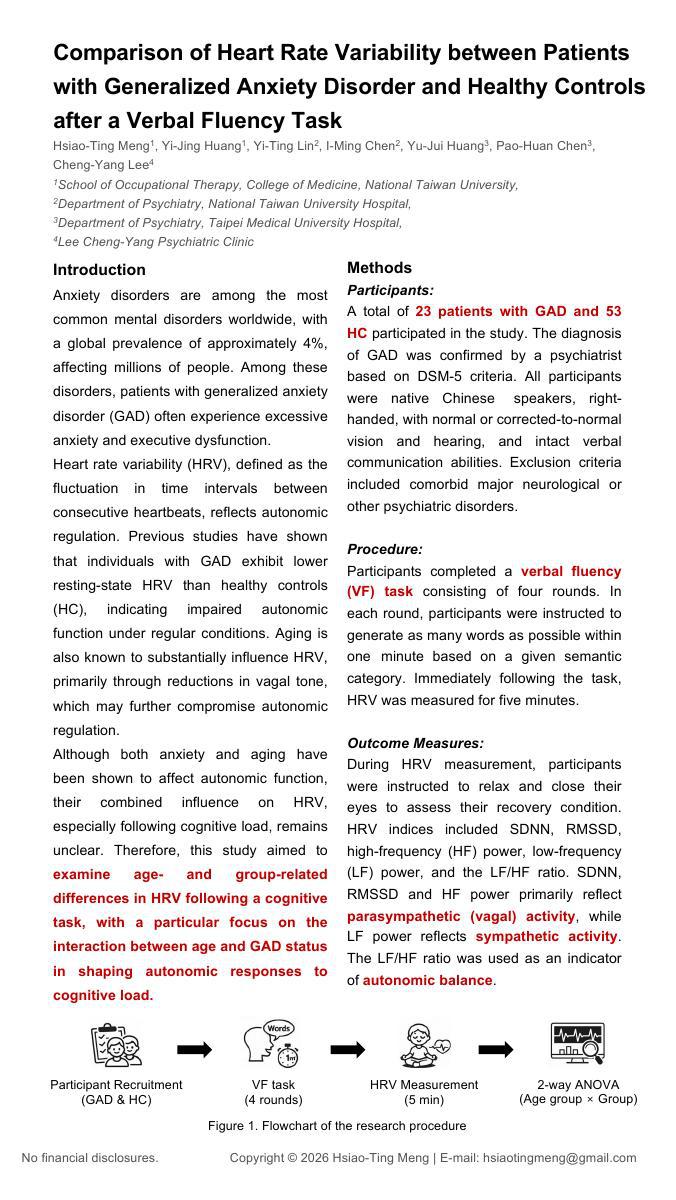
Introduction / Rationale: Patients with generalized anxiety disorder (GAD) experience excessive anxiety and executive dysfunction. Heart rate variability (HRV), the fluctuation in time intervals between consecutive heartbeats, reflects autonomic balance. GAD exhibit lower resting-state HRV than healthy controls (HCs), indicating impaired autonomic function under regular conditions. However, the effects of cognitive tasks on HRV in GAD remains unclear.
Objectives: This study compared HRV between GAD and HCs following a verbal fluency (VF) task to evaluate autonomic regulation following cognitive load.
Methods / Approach: Twenty-three GAD and 34 HCs were recruited. HRV was measured for five minutes following four rounds of the VF task, where participants generated as many words as possible within one minute based on a given semantic category. Between-group differences in HRV indices, including heart rate, low-frequency (LF) power (sympathetic activity), high-frequency (HF) power (parasympathetic activity), and LF/HF ratio (autonomic balance), were analyzed using the Mann-Whitney U tests.
Results / Practice Implications: GAD exhibited significantly higher LF power, HF power, and heart rate compared to HCs (p = .043, .002, and .032, respectively), but a significantly lower LF/HF ratio (p = 0.35).
Conclusion / Significance to the Occupational Therapy Profession: During recovery from VF task, GAD exhibited elevated heart rate and sympathetic activity, indicating sustained heightened vigilance. While parasympathetic activity also increased significantly, the significantly lower LF/HF ratio suggests a compensatory parasympathetic response to counterbalance excessive sympathetic activation. However, this compensation appeared insufficient to suppress heart rate and sympathetic activity, suggesting impaired autonomic regulation in GAD.