
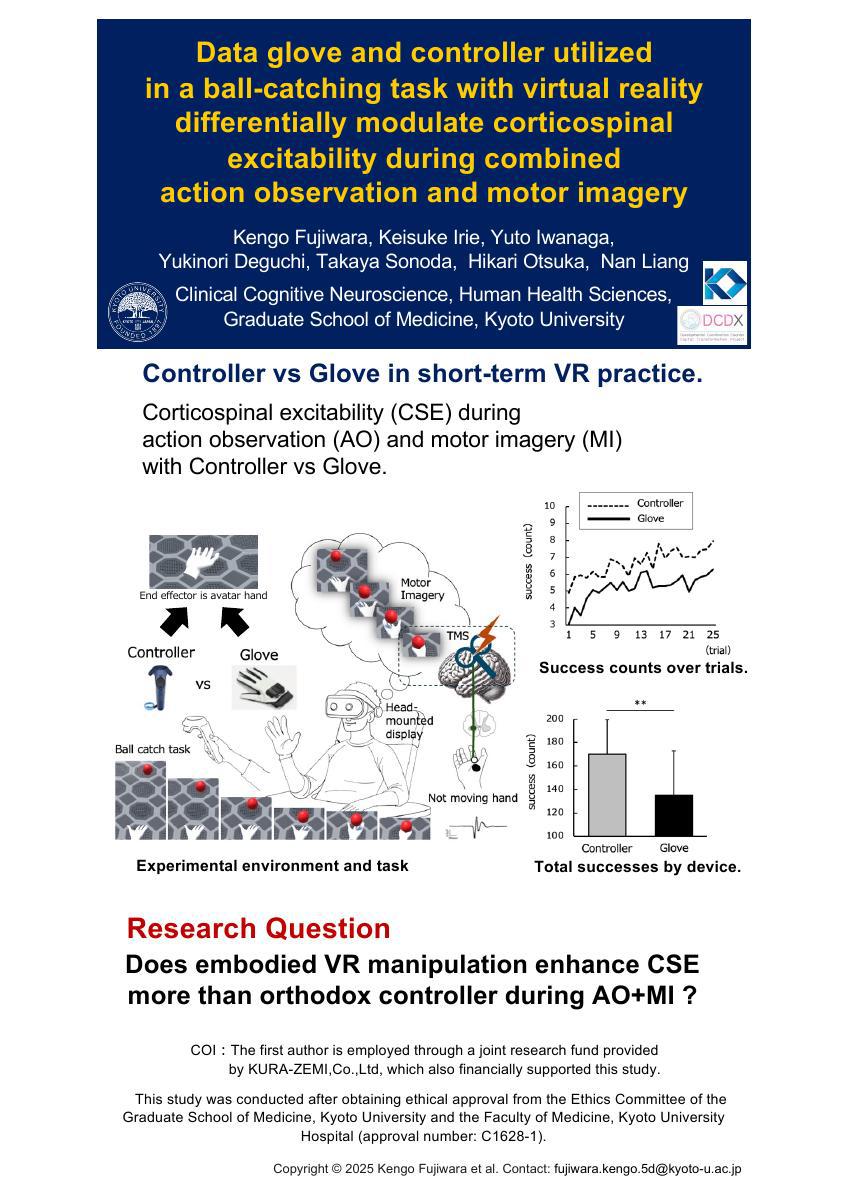
Introduction: Previous studies showed performance, body ownership, and agency differences between Controller and Data Glove (Glove) in VR, but their impact on corticospinal excitability (CSE) remained unclear. We investigated the muscles and CSE involved in the ball-catching task.
Method:
Twenty healthy adults were randomly assigned to either the Controller or Glove group and performed an action observation (AO) + motor imagery (MI) task, imagining themselves catching a ball in a VR environment. Participants performed the ball-catching task 250 times. Before and after the task, they performed AO+MI, and CSE was assessed using transcranial magnetic stimulation. Assessments also included electromyography of the agonist muscles (thenar and FDI muscles), success rate of ball-catching task, MI vividness, and subjective measures of body ownership and agency. This study was approved by the Ethics Committee of the Graduate School of Medicine.
Result: The success rate of ball-catching was higher in the Controller than Glove group throughout the trials, while no difference in MI vividness was observed. Thenar muscle activity significantly decreased in the Glove group across trials. In contrast, CSE in the Glove group, represented by MEPs of the thenar, showed a significant increase. A significant correlation was observed between MEPs and EMG activity recorded from the thenar and FDI muscles.
Conclusion:
These results suggest that the CSE increase during AO+MI in the Glove group was driven by short-term learning of the ball-catching task. However, these changes were absent in the Controller group.