
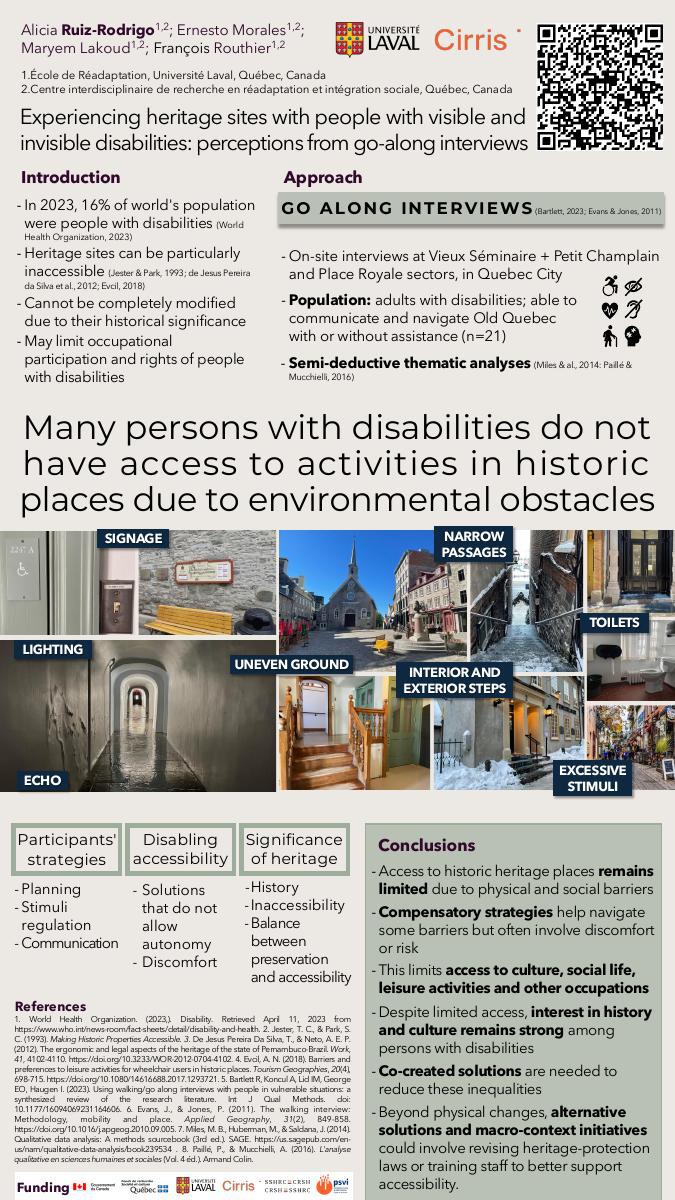
Introduction. People with disabilities (PWD) represent 16% of the world's population. Historic sites, built before accessibility standards and PWD rights, were mostly not designed to be accessible. They cannot be easily modified due to their historical significance and conservation laws. These sites serve functions like culture, tourism, and everyday activities. The rights and occupations of PWD are often compromised in these sites.
Objective. To explore experience of PWD in visiting heritage places and identify environmental barriers.
Methods. This qualitative interpretive description study included 21 adults with visible (e.g.,wheelchair user) or invisible (e.g.,autism) disabilities. Each completed go-along interviews in two different locations in Old-Quebec. Thematic analysis was done.
Results. Participants visited Old-Quebec to enjoy the atmosphere, cultural activities or events (e.g.,shows) or to go to local restaurants/bars. However, these activities were limited by environment barriers, such physical (e.g.,uneven floor), social (e.g.,noise, crowds) or organizational elements (e.g., cleanliness). Participants had developed strategies to deal with obstacles, such as detailed planning of their visit or seeking out quiet places to reduce stimuli, which can represent an additional burden. Most participants associated heritage to history or origins and viewed heritage places as having special character, important to experience. Most participants claimed that there should be a balance between accessibility and heritage conservation.
Conclusion. A broader disability definition leads to inclusive accessibility solutions that facilitate the occupations and participation of the entire PWD community. Identifying barriers and solutions have contributed to provide informed recommendations for developing accessibility standards for heritage sites in Canada, contributing significantly at a macro environment level.