
Introduction: Sensory processing is essential for child development and is often associated with developmental disorders. However, Indonesia lacks standardized tools for assessing sensory processing difficulties in preschool children. The Sensory Processing Measure, Second Edition (SPM-2), is widely used in English and other languages, but an Indonesian version has not been developed. This study aims to address this gap by translating, culturally adapting, and validating the SPM-2 for use in Indonesia.
Objectives: To translate, culturally adapt, and evaluate the validity and reliability of the Indonesian version of SPM-2 for preschool children.
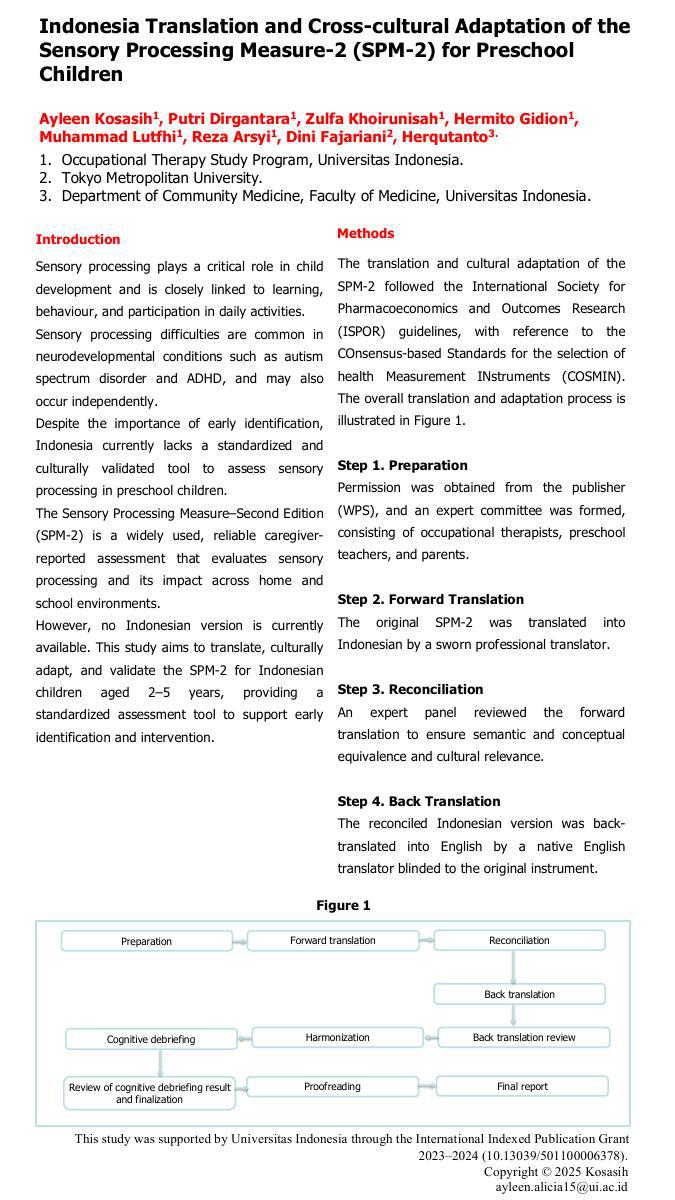
Methods: The study followed the ISPOR guidelines for patient-reported outcomes (PRO) measures. The 10-step process included preparation, forward translation, reconciliation, back translation, review, harmonization, cognitive debriefing, result review, finalization, proofreading and reporting. A multidisciplinary expert panel refined terminology and cultural relevance. The finalized version was submitted to Western Psychological Services (WPS) for review, and a pilot study is planned for 2025 to assess validity and reliability.
Result: The translation and adaptation process in 2024 demonstrated high semantic consistency with the original version. Cognitive debriefing confirmed that parents and teachers found the translated items clear and culturally appropriate. The finalized version is now prepared for psychometric evaluation. A 2025 pilot study will evaluate validity and reliability using content validity indexing and Cronbach’s alpha.
Conclusion: This study marks the first phase of developing an Indonesian SPM-2, a crucial step for preschool children in Indonesia. The next phase will focus on psychometric validation to ensure the tool’s reliability and applicability in occupational therapy practice.