
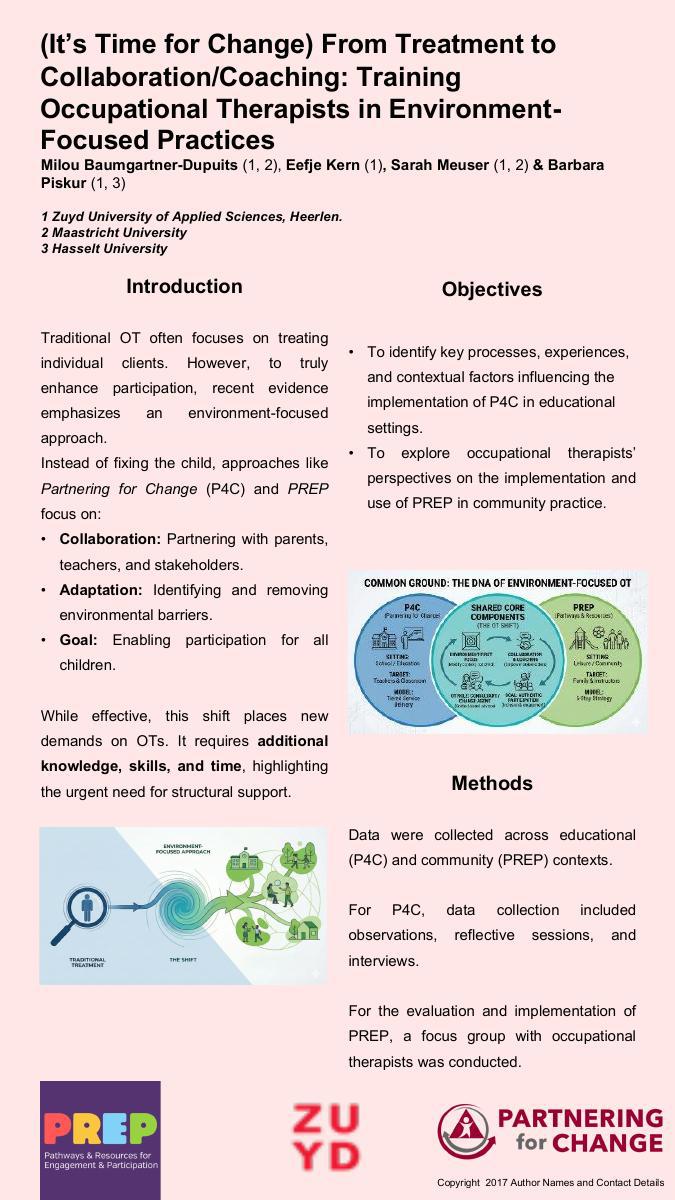
Introduction / Rationale: Traditional occupational therapy (OT) often focuses on treating individual clients. However, to enhance the participation of children and youth, recent studies emphasize a shift towards an environment-focused approach. Interventions such as Partnering for Change (P4C) and Pathways and Resources for Engagement and Participation (PREP) emphasize collaboration with parents, teachers, and other stakeholders to identify environmental barriers to participation, share perspectives, and to adapt the environment to enable participation. However, these approaches require additional knowledge and skills from OTs, which demands both time and support.
Objectives: Drawing from our experiences with implementing P4C and PREP in various settings, we will share best practices and key lessons learned in supporting OTs as they transition from direct treatment to an environment-focused approach.
Methods / Approach: During various support sessions for OTs, qualitative data were collected through observations, reflective sessions, and interviews with OTs and other stakeholders.
Results / Practice Implications: Our results indicate that a range of support strategies is essential to facilitate OTs in their transition. These include training modules to enhance knowledge, practical tools to foster collaboration with stakeholders and focus on environmental adaptations, regular intervision meetings to encourage peer learning, and on-the-job coaching for hands-on guidance. Furthermore, successful implementation requires agreements on organization and financing of these environment-focused approaches.
Conclusion / Significance to the Occupational Therapy Profession: Supporting OTs in transitioning to an environment-focused approach requires more than training—it calls for ongoing collaboration and reflective learning. This shift enhances OTs professional role and strengthens their impact on inclusive participation for all children.