
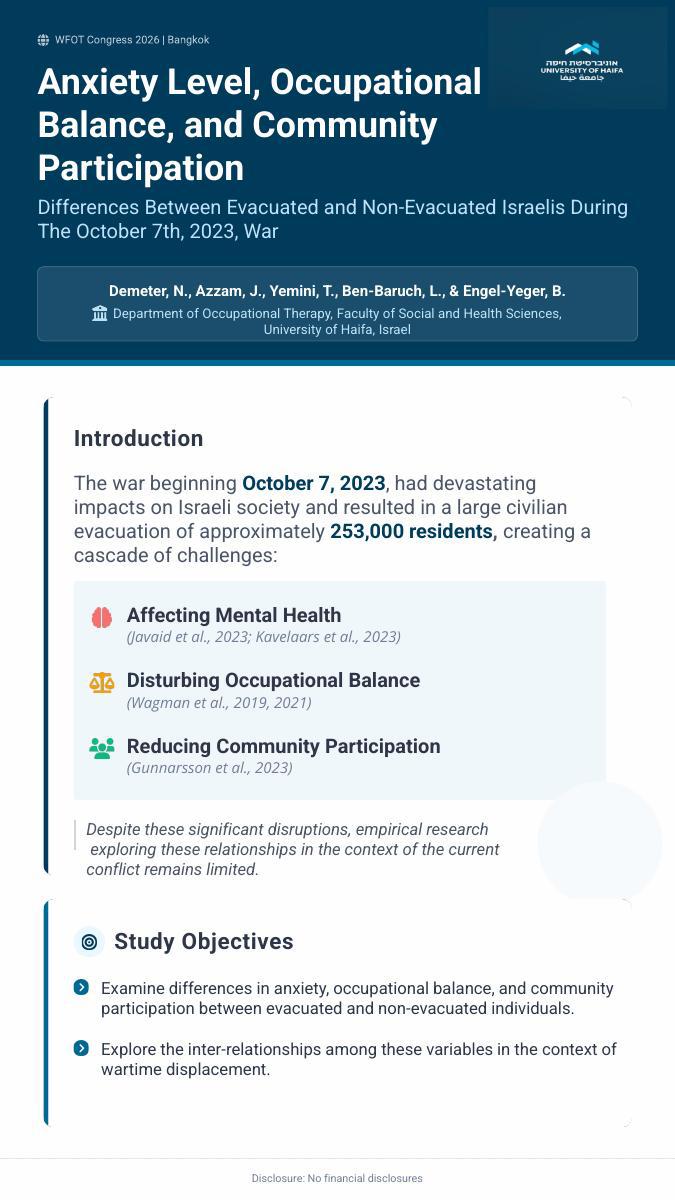
Introduction: The war beginning October 7, 2023, had devastating impacts on Israeli society and resulted in a large civilian evacuation (253,000 residents). Wartime evacuation disrupts daily routines, affecting mental health, occupational balance, and community participation, yet empirical research exploring these relationships remains limited.
Objectives: To examine differences in anxiety levels, occupational balance, and community participation between evacuated and non-evacuated individuals, and explore the inter-relationships among these variables.
Methods: This cross-sectional study included 103 participants (35 evacuated, 68 non-evacuated) who completed the GAD-7, Occupational Balance Questionnaire, and Community Participation Indicators online, and analyzed using t-tests, and correlations.
Results: Evacuated participants showed higher anxiety levels and a lower sense of inclusion in the community (=enfranchisement). No significant differences in occupational balance were found between groups. Participants with anxiety demonstrated lower occupational balance and a lower sense of inclusion in the community (enfranchisement). Significant correlations existed between anxiety and occupational balance (r=-0.405, p<.001), anxiety and enfranchisement control (r=0.334, p<.001), occupational balance and enfranchisement control (r=-0.619, p<.001), and enfranchisement importance (r=-.332, p<.001).
Conclusion/Implications: The findings demonstrate the critical role of occupational therapy in supporting individuals experiencing displacement. Occupational therapists can develop targeted interventions that address the interconnected challenges of anxiety, disrupted occupational balance, and reduced community participation. The research underscores the importance of holistic, client-centered approaches that support psychological resilience and social engagement during and after crises. Occupational therapy interventions should focus on empowering individuals to rebuild their sense of purpose, restore occupational identity, and re-establish community connections in the aftermath of traumatic displacement