
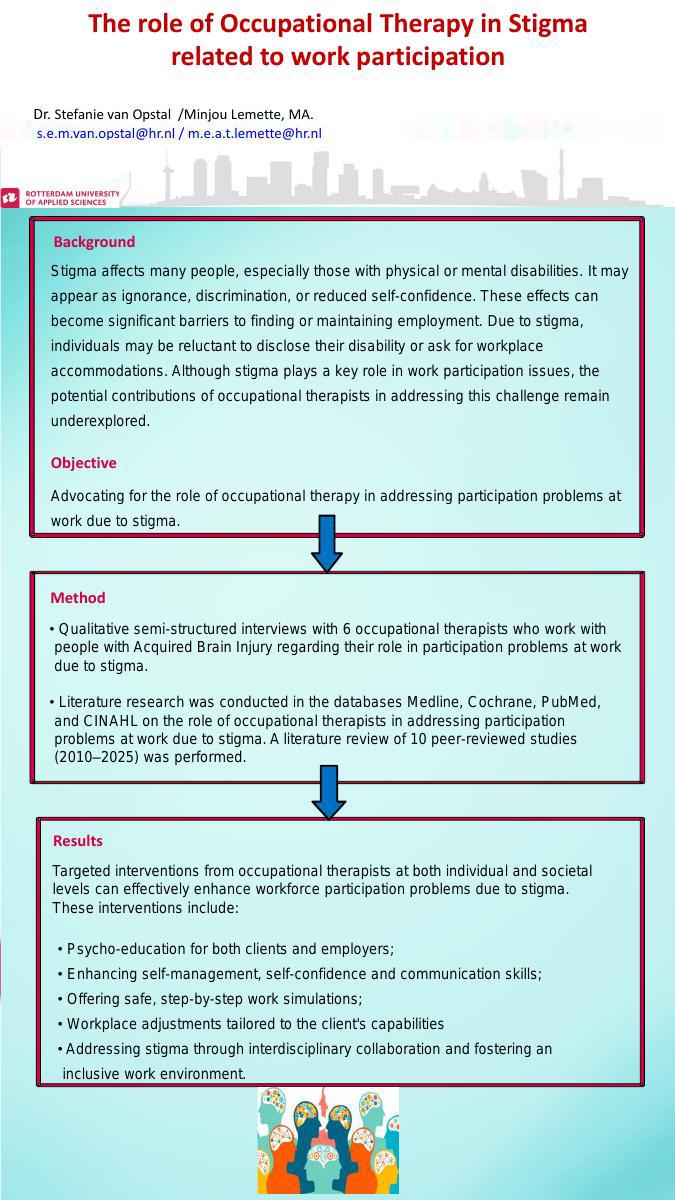
Introduction: Stigma can play a role in everyone's life, especially when there is a physical or mental disability. Stigma can reveal itself as ignorance from the environment, reduced self-confidence, and discrimination. As a result, stigma can create a barrier to work participation. Stigma can make it more difficult for people to find employment or maintain employment. In addition, they may be hesitant to discuss their disability and express their need for accommodations at work. Despite the fact that stigma can play a major role in participation problems at work, little is known about what an occupational therapist can do in this area.
Objectives
- Advocating for the role of occupational therapy in addressing participation problems at work due to stigma
Methods
- Qualitative interviews with occupational therapists regarding their role in participation problems at work due to stigma
- Literature research on the role of occupational therapists in participation problems at work due to stigma
Results: Targeted interventions at both individual and societal levels can effectively enhance workforce participation;
- Individual: Self-management and empowerment strategies.
- Environmental : Awareness and education for employers and colleagues.
- Structural: Policy advice and workplace adjustments.
Occupational therapists play a key role in strengthening clients' work skills and self-confidence while also engaging employers and policymakers in fostering an inclusive work environment.
Conclusion:Stigma can form a complex barrier to work participation. Occupational therapists should be aware they can play a crucial role in reducing stigma and promoting inclusion. This should receive attention within OT education.