Introduction: Competence for occupation-centred practice involves deep understanding of occupation. How students develop this competence is not well understood, yet occupation-centred education has been proposed. This approach to teaching requires a deliberate design of educational experiences, where students relate subjects and learning outcomes to occupation. Yet, research demonstrates that educators often think they explicitly teach occupation, when occupation is absent or indirectly taught. Transforming into an occupation-centred curriculum is not evident.
Objectives: To share lessons learned about how to transform into an occupation-centred curriculum.
Approach: This transformation process involved several efforts
• Establishment of a steering committee
• Involvement of clinical instructors
• Facilitation of journal clubs to discuss key concepts, including research about occupation-centred teaching from different perspectives
• Practical exercises and presentations across faculty staff
• International collaboration:
o Inspirational kick-off videos (Australia)
o Online workshops about the Subject-Centered Integrative Learning Model (USA)
o Study trips to exchange knowledge (Canada)
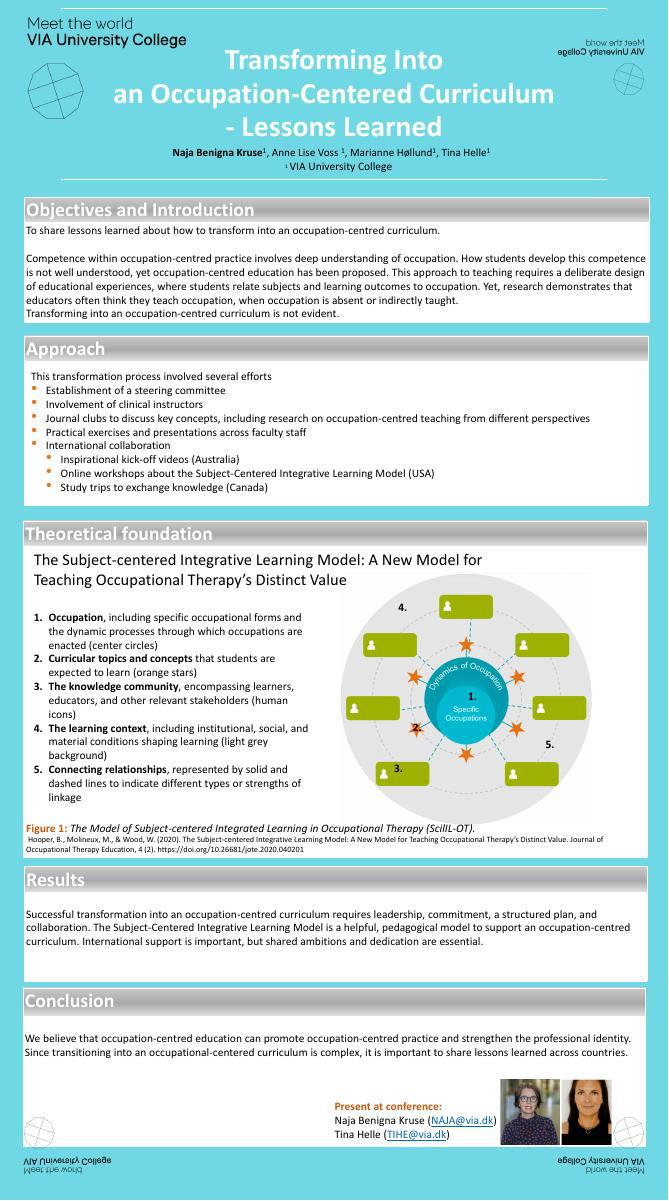
Results: Successful transformation into an occupation-centred curriculum requires leadership, commitment, a structured plan, and collaboration. The Subject-Centered Integrative Learning Model is a helpful, pedagogical model to support an occupation-centred curriculum. International support is important, but shared ambitions and dedication are essential.
Conclusion: We believe occupation-centred education can promote occupation-centred practice and strengthen the professional identity. Since transitioning into an occupational-centered curriculum is complex, it is important to share lessons learned across countries.
