
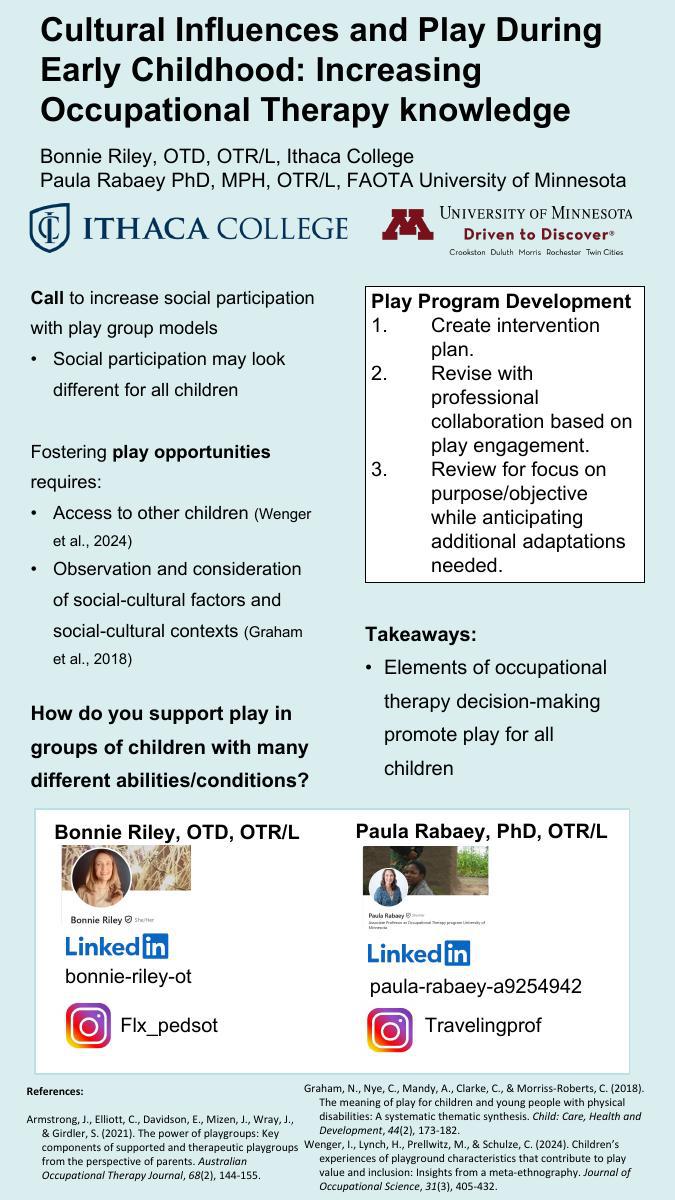
Introduction/Rationale: Play is an opportunity for children to increase social participation. Culturally accessible play relies on inclusive responsiveness to social-cultural factors and contexts to promote development and well-being in early childhood. The desired outcome of culturally accessible play is engagement in play for all children and achieved through interprofessional knowledge sharing and clarifying the unique contributions of occupational therapy.
Objectives: This study describes themes that impact culturally accessible play in early childhood and identifies elements of occupational therapy decision making necessary to promote play for all children.
Methods/Approach: A grounded theory approach was initiated to describe considerations for adapting play interventions amongst at-risk or marginalized children. Data from early childhood professionals and occupational therapy students who have implemented play interventions provides considerations for culturally-responsive play, including the specific contributions of occupational therapy.
Results / Practice Implications: Projected themes emphasize the importance of access to other children, the influence of social factors, and contextual considerations for fostering play opportunities. Components of occupational therapy decision-making that support culturally accessible play include strategies for promoting co-regulation with evolving activity and environment analysis.
Conclusion / Significance to the Occupational Therapy Profession: Occupational therapy practitioners have skills to develop communities that inspire culturally accessible play for all children. Increasing play opportunities is important to promote early childhood development, minimize social risk factors, and promote childhood co-occupations in an everchanging world.