
Introduction
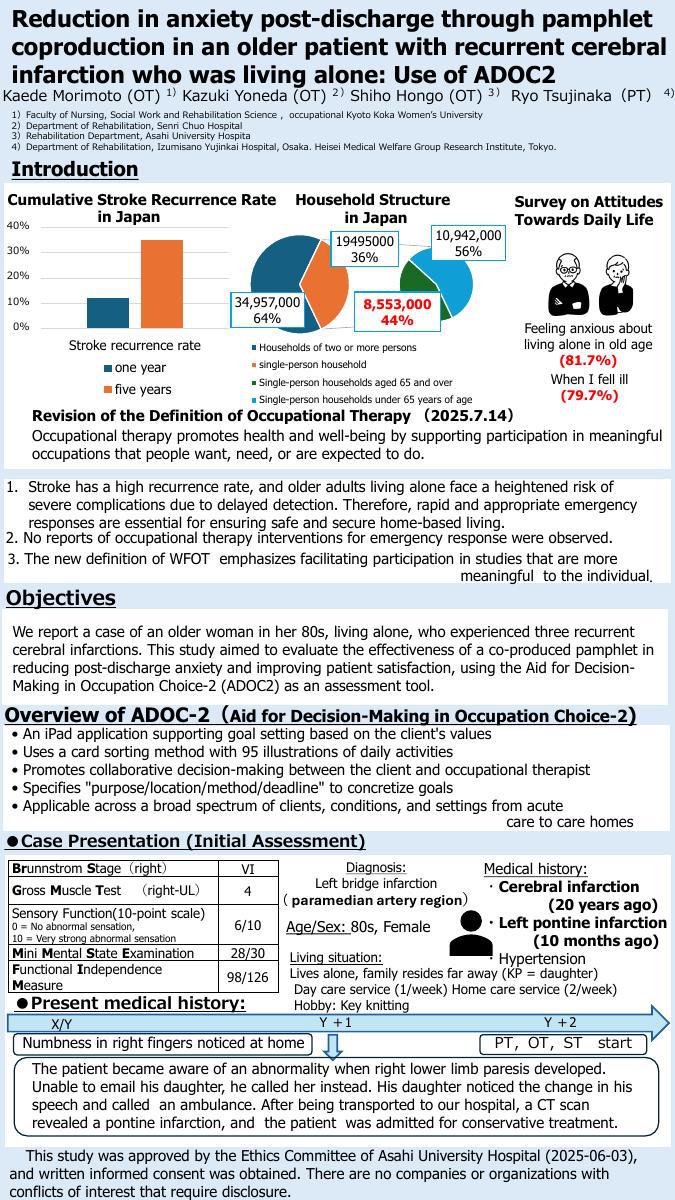
In Japan, there are 8,553,000 single-person households aged 65 or older. The five-year cumulative recurrence rate of stroke is approximately 35%. For these reasons, Great care must be taken to prevent stroke recurrence in elderly people living alone, and patient education on how to respond in an emergency is important.
Objectives
We report a case of an elderly woman in her 80s living alone who experienced three recurrent cerebral infarctions. This study aimed to evaluate the effectiveness of a coproduced pamphlet in reducing post-discharge anxiety and improving patient satisfaction, using the Aid for Decision-Making in Occupation Choice-2 (ADOC2) as an assessment tool.
Approach
Using ADOC2, A pamphlet focusing on “handling emergency situations,” identified as a valuable task, was jointly produced, and occupational therapy was practiced using patient education. Asahi University Hospital approved the study, and we obtained the patient's written consent after explaining it to her.
Results
ADOC2 results were initially 1 for both satisfaction and implementation. The patient, who scored 8 on the anxiety numerical rating scale (NRS), saw satisfaction improve to 4 after a pamphlet on emergency situations was created, while implementation remained at 1. The NRS score dropped to 3, indicating reduced anxiety.
Conclusion
The patient proactively engaged in occupational therapy by making informed decisions and identifying valuable tasks using the ADOC2. From a patient education perspective, the collaborative production of the pamphlet helped the patient to manage emergencies proactively. This process also improved her satisfaction, which may have contributed to reduced anxiety after discharge.