
Introduction: Post-secondary students face unique occupational challenges requiring adaptation as they configure new identities. Mental health concerns and academic pressures significantly impact student success. While occupational adaptation theory provides a framework for understanding the transition, current instruments fail to capture how occupation influences adaptation in this population. This research addresses this gap through the development of a theoretically-grounded, online assessment tool.
Objectives: Develop and validate a theoretically-grounded occupation-focused tool; establish face and content validity; evaluate psychometric properties; establish connection between mental health and occupational adaptation; clarify personalized real-time feedback to respondents.
Methods: The tool has been developed through multiple iterations between experts, students, and the research team. The tool is currently undergoing pilot testing with a large sample to determine final structure and to establish reliability and construct validity.
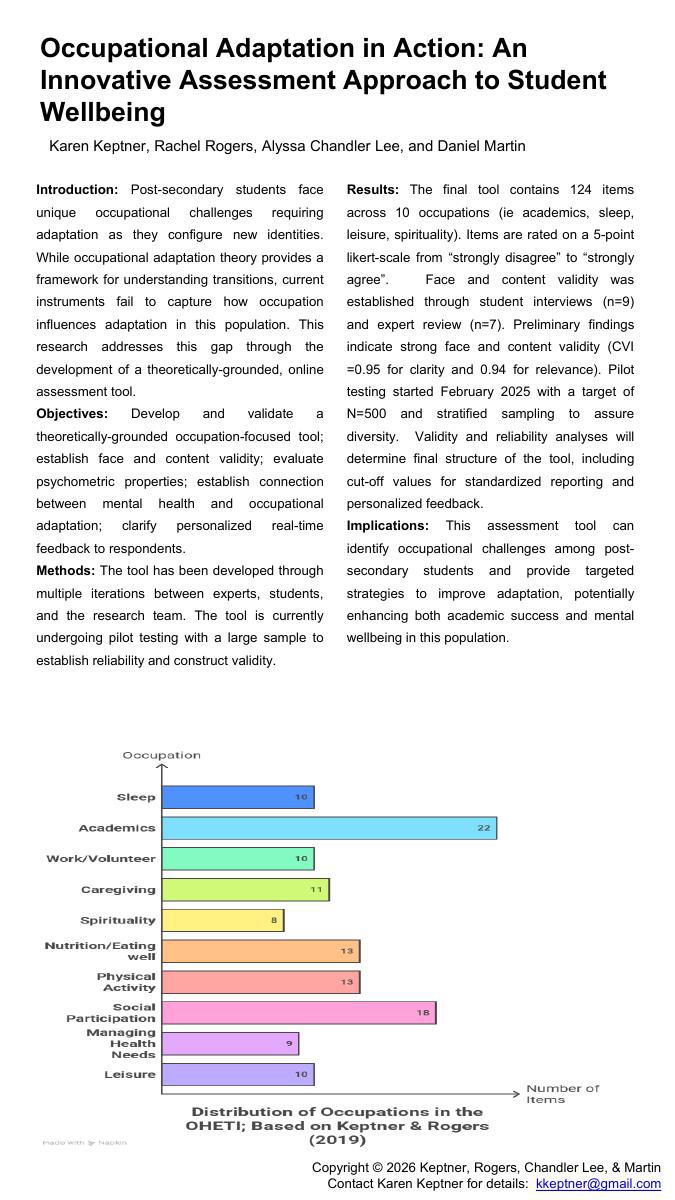
Results: The final tool contains 124 items across 10 occupations (ie academics, sleep, leisure, spirituality). Items are rated on a 5-point likert scale from “strongly disagree” to “strongly agree”. Face and content validity was established through student interviews (n=9) and expert review (n=7). Preliminary findings indicate strong face and content validity (CVI =0.95 for clarity and 0.94 for relevance). Pilot testing started February 2025 with a target of N=500 and stratified sampling to assure diversity. Validity and reliability analyses will determine final structure of the tool, including cut-off values for standardized reporting and personalized feedback.
Implications: This assessment tool can identify occupational challenges among post-secondary students and provide targeted strategies to improve adaptation, potentially enhancing both academic success and mental wellbeing in this population.