
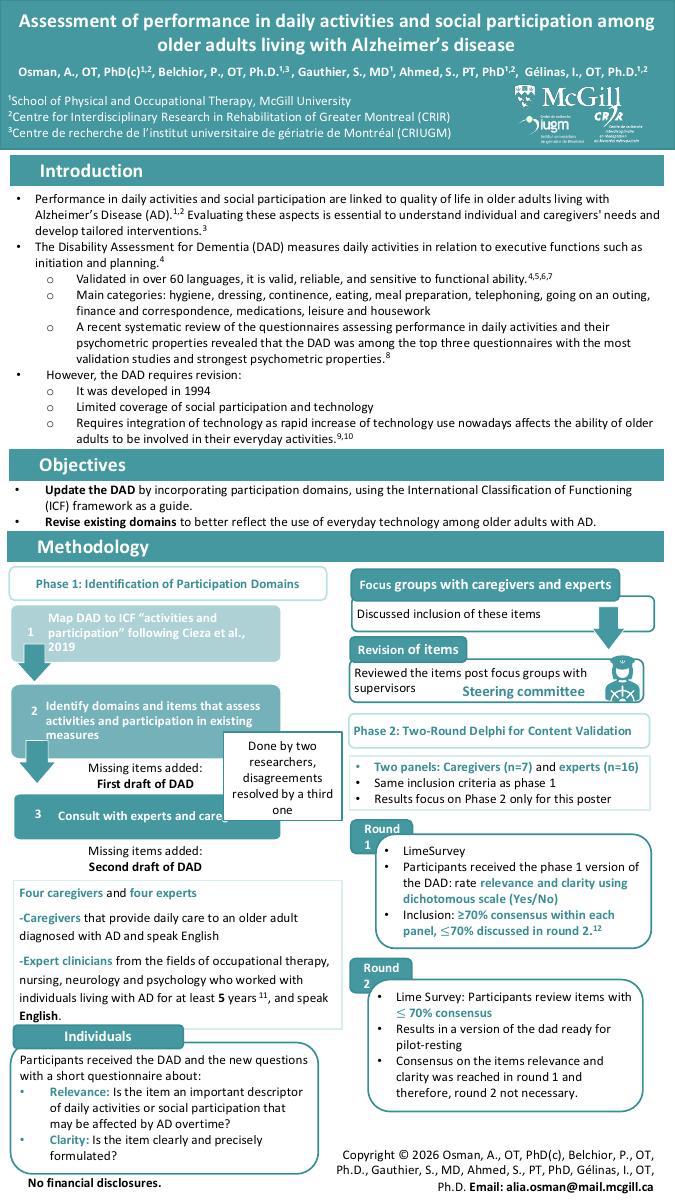
Introduction: Performance in daily activities and social participation is associated with quality of life among older adults living with Alzheimer’s Disease (AD). Assessing these constructs is important to identify the needs of the person and their family, design targeted interventions, and evaluate their effectiveness. The Disability Assessment for Dementia (DAD), a widely validated tool, evaluates basic and instrumental activities of daily living (BADLs and IADLs) while integrating executive functions (e.g. initiation, planning, etc.). However, its limited coverage of social participation and everyday technology requires revision.
Objectives: 1) To update the DAD by adding participation domains, guided by the International Classification of Functioning (ICF) framework and 2) to review existing domains to include everyday technology use among older adults living with AD.
Methods: The methodology involves three phases: (1) Identification of participation domains and items to be added through mapping DAD to ICF subdomains, literature review, and expert/caregiver consultations; (2) Content validation of a preliminary revised version of the DAD using the Delphi method with experts and caregivers; and (3) Pre-testing the revised measure with caregivers to ensure comprehensiveness.
Results: The mapping exercise revealed missing “activities and participation” domains in the DAD. These domains and everyday technology use were added to the revised DAD. Content validation and pre-testing results of this updated measure will be presented at the conference.
Conclusion: The revised DAD will provide occupational therapists with a comprehensive and validated tool to assess activities and participation, including technology use, to better guide interventions for older adults living with AD.