
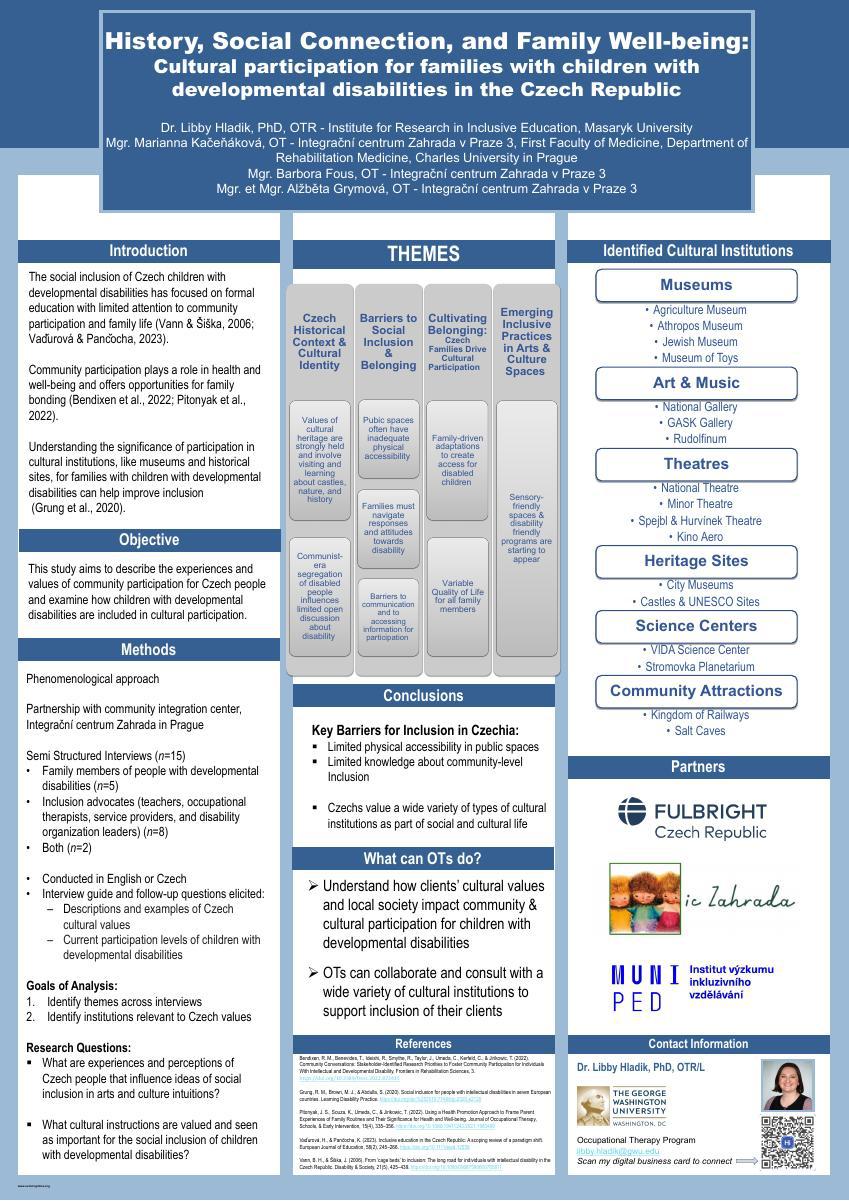
Rationale: The social inclusion of Czech children with developmental disabilities has focused on formal education with limited attention to community participation and family life. Community participation plays a role in health and well-being and offers opportunities for family bonding. Understanding the significance of participation in cultural institutions, like museums and historical sites, for families with children with developmental disabilities can help improve inclusion.
Objective: This study aims to describe the experiences and values of community participation for Czech people and examine how children with developmental disabilities are included.
Methods: Through a university research institute and school/community integration center partnership, interviews (n = 25) were conducted with family members and inclusion advocates of children with developmental disabilities. Semi-structured interviews were utilized to gather descriptions and examples of Czech cultural values and the current participation levels of children with developmental disabilities. Thematic Analysis was conducted to find themes across interviews and identify institutions relevant to Czech cultural values.
Results: Preliminary themes include History, Social Connection, and Family Well-being as key values for Czech cultural participation. Additionally, people with disabilities face physical accessibility barriers and general lack of knowledge about accessibility and inclusion. A list of cultural institutions for potential collaboration to improve inclusion and accessibility will be provided.
Conclusion: The findings of this study can help occupational therapists collaborate with cultural institutions to support the inclusion of children with developmental disabilities in social participation. OTs worldwide can consider how cultural values of their clients and local society impact community and cultural participation.