
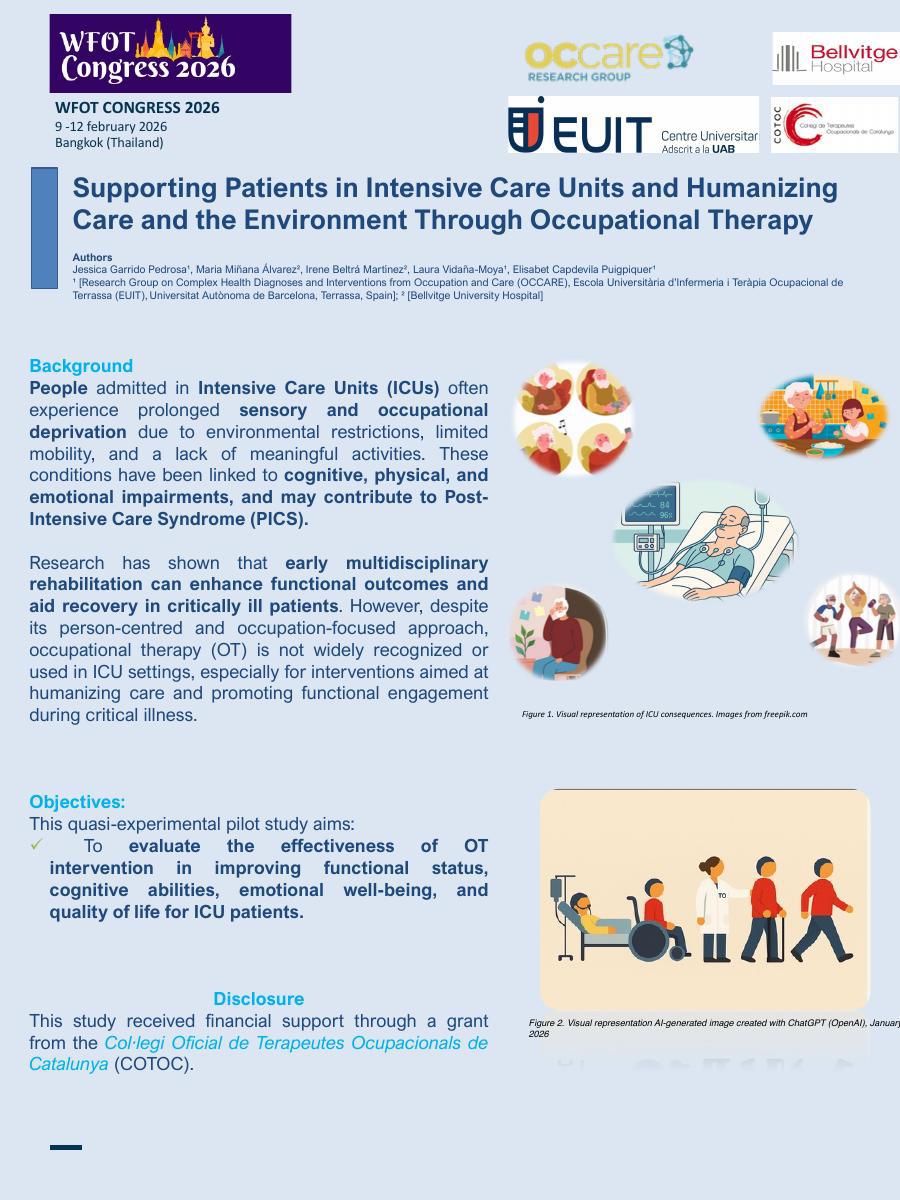
Introduction / Rationale: Patients in Intensive Care Units (ICUs) often experience sensory and occupational deprivation, which can lead to cognitive, physical, and emotional impairments, including Post-Intensive Care Syndrome (PICS). Early multidisciplinary rehabilitation is known to enhance functional recovery; however, occupational therapy (OT) is often underrecognized in this context.
Objectives: This quasi-experimental pilot study aims to evaluate the effectiveness of OT intervention in improving functional status, cognitive abilities, emotional well-being, and quality of life for ICU patients. Secondary objectives include assessing improvements in mobility and long-term functional independence.
Methods / Approach: This quasi-experimental pilot study involves adult ICU patients at the Hospital Universitari de Bellvitge. Participants will receive individualized OT sessions lasting 20 to 30 minutes each day. These sessions will include reality orientation, cognitive and sensorimotor stimulation, activities of daily living, and environmental adaptations. Pre- and post-intervention assessments will utilize validated scales to measure functional, cognitive, and emotional status. Statistical analysis will be conducted using IBM-SPSS.
Results / Practice Implications: Preliminary results suggest that early OT intervention significantly enhances both functional and emotional recovery, helping to mitigate the adverse effects associated with ICU stays and promoting reintegration into daily life.
Conclusion / Contribution to the Occupational Therapy Profession: This study highlights the essential role of OT in ICU care and advocates for its integration into multidisciplinary teams. The findings provide evidence that OT is an effective intervention in critical care, reinforcing their importance in improving patient outcomes.