
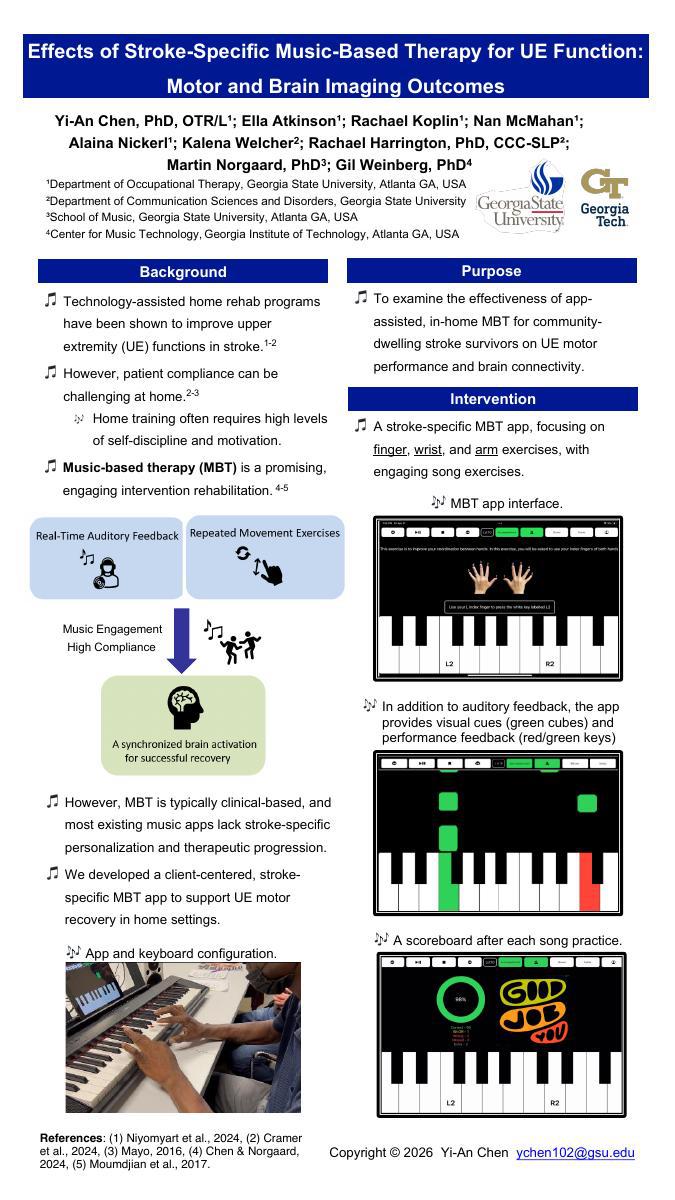
Introduction/Rationale. Music-based therapy (MBT) shows promise for stroke rehabilitation, but existing music apps lack the personalization needed for stroke recovery. Our team developed a client-centered MBT app to improve upper extremity (UE) function in stroke survivors.
Objectives. To examine the effectiveness of app-assisted, in-home MBT for community-dwelling stroke survivors.
Methods/Approach. Participants in a 4-week MBT program receive a piano keyboard and an iPad with the app, and are encouraged to practice UE exercises daily. Pre- and post-assessments include the Fugl-Meyer Assessment (FMA), 9-Hole Peg Test (9-HPT), and resting-state fMRI.
Results/Practice Implications. Data collection is ongoing, with two participants completing the program. Both reported increased motivation for home-based exercise with the app. Notable improvements were observed in FMA scores (increased 6-7 points) and 9-HPT times (changed 4.1 to 24.6 seconds), suggesting enhanced UE movement, dexterity, and coordination. fMRI revealed increased resting-state connectivity from the left superior temporal gyrus and Heschl’s gyrus to bilateral primary motor cortices and the left temporoparietal regions. Additionally, increased connectivity was observed from the left primary motor cortex and supplementary motor area to the bilateral motor cortices' hand knob and small clusters in the bilateral middle temporal gyri and left superior temporal gyrus.
Conclusion/Significance to the Occupational Therapy Profession
Preliminary findings suggest that the MBT app may improve motor function in stroke survivors, with observed brain connectivity and activation changes supporting its potential. This study underscores the importance of engaging, personalized home rehabilitation strategies. Ongoing data collection aims to provide robust evidence with a larger sample size.