
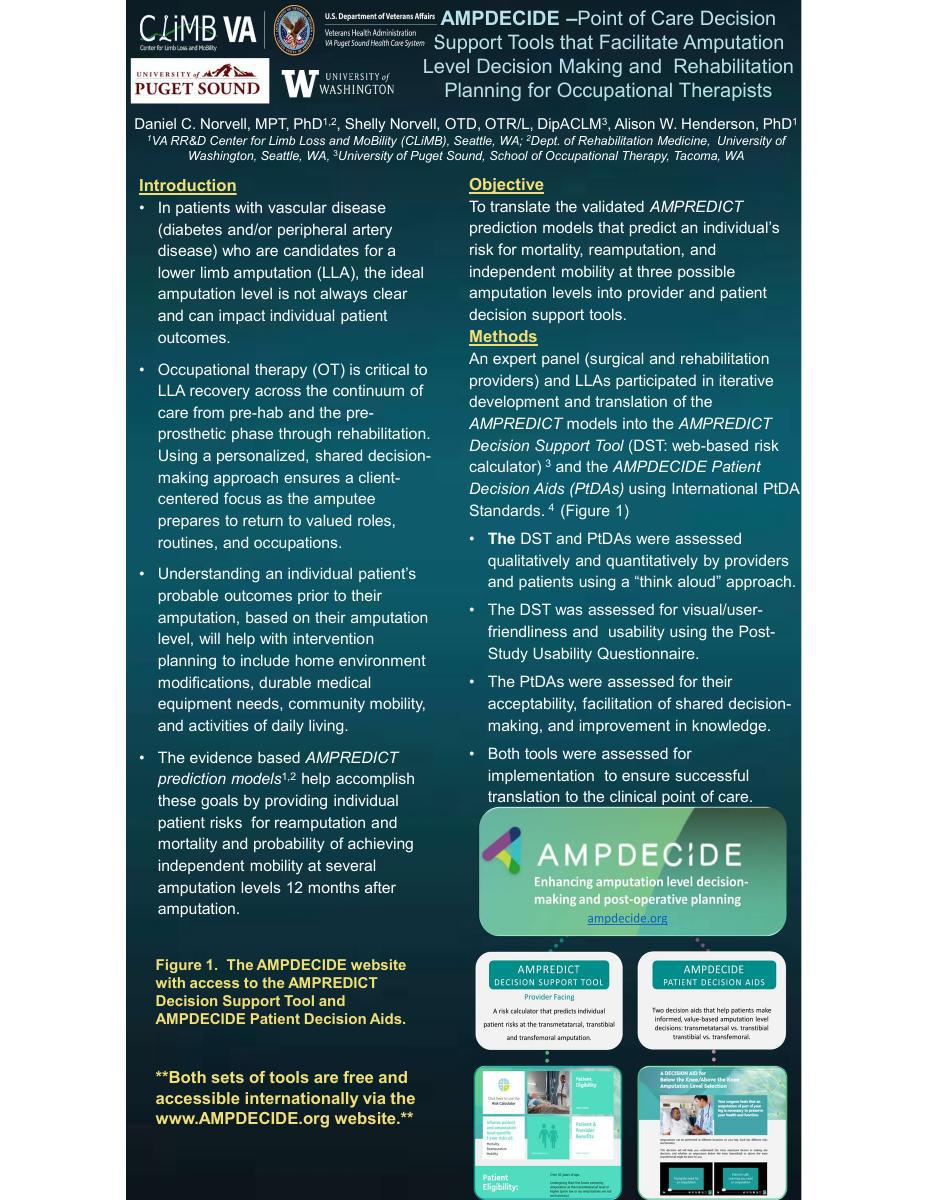
Intro/Rationale: Occupational therapy (OT) is critical in rehabilitation following lower limb amputation (LLA). To maximize daily functional abilities, a personalized and shared decision making (SDM) approach to aid in regaining independence is paramount. The evidence based AMPREDICT decision support tool (DST) and AMPDECIDE Patient Decision Aids (PtDA) are practical tools to accomplish these goals.
Objectives: To translate the validated AMPREDICT prediction models that predict an individual’s risk for mortality, reamputation, and independent mobility at three possible amputation levels into provider and patient decision support tools.
Methods/Approach: An expert panel (surgical and rehabilitation providers) and LLAs participated in iterative development and translation of the AMPREDICT models into the AMPREDICT DST (web-based risk calculator) and the AMPDECIDE PtDAs using International Patient Decision Aid Standards. The DST and PtDAs were assessed qualitatively and quantitative by providers (n=26) and patients (n=18) using a “think aloud” approach. The DST was assessed for visual/user-friendliness and usability. The PtDAs were assessed for their acceptability, facilitation of SDM, and improvement in knowledge.
Results/Practical Implications: Usability scores of the AMPREDICT DST were highly favorable. Potential clinical utility included: (1) counseling patients on amputation level decisions, (2) setting expectations, and (3) assisting discharge/rehabilitation planning. For the AMPDECIDE PtDAs, greater than 80% of patients would have liked to participate in their amputation level and rehabilitation decisions and demonstrated improved knowledge.
Conclusion/Significance to the Occupational Therapy Profession: The AMPREDICT DST and AMPDECIDE PtDAs (www.ampdecide.org) demonstrated strong usability characteristics and clinical relevance for OTs to assist in shared discharge/rehabilitation planning to maximize independence.