
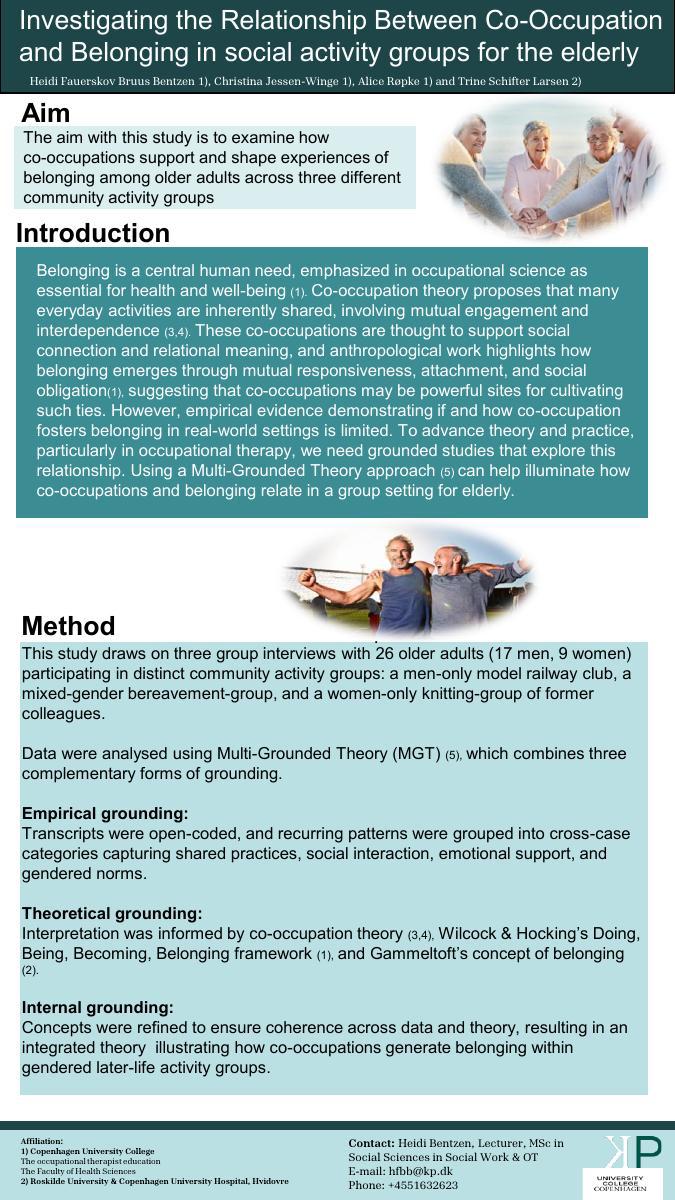
Introduction / Rationale:Co-occupations, involving shared activities that are socially interactive and mutually engaging, have the potential to foster a sense of belonging among participants (1,2). Belonging, as described by Ann Wilcock (3) and Tine Gammeltoft (4), emphasizes the importance of social connections and the sense of community involvement. Despite theoretical connections, empirical research exploring this relationship between belonging and co-occupation is needed to help occupational therapists design interventions that leverage social aspects of co-occupations to enhance participants’ sense of belonging.
Objective: This project aims to investigate how co-occupation relates to belonging as described by Wilcock (3) and Gammeltoft (4), providing insights into the social dimensions of occupational engagement and informing group interventions in occupational therapy to reduce loneliness.
Methods / Approach: A multi-grounded theory study (5) consisting of a scoping review on co-occupation in occupational therapy and occupational science, and qualitative interviews with elderly participants in social activity groups to explore their experiences of co-occupation and belonging (6).
Results / Practice Implications: The scoping review has identified various definitions of co-occupation and a gap in empirical studies. All definitions emphasize interactivity, relating to belonging as individuals engage in shared activities that reinforce social bonds. The qualitative interviews will empirically explore this relationship.
Conclusion / Contribution to the occupational therapy profession:Findings will have important implications for occupational therapy practice, particularly in designing interventions that promote social connections and community integration, supporting clients' overall health and well-being.