
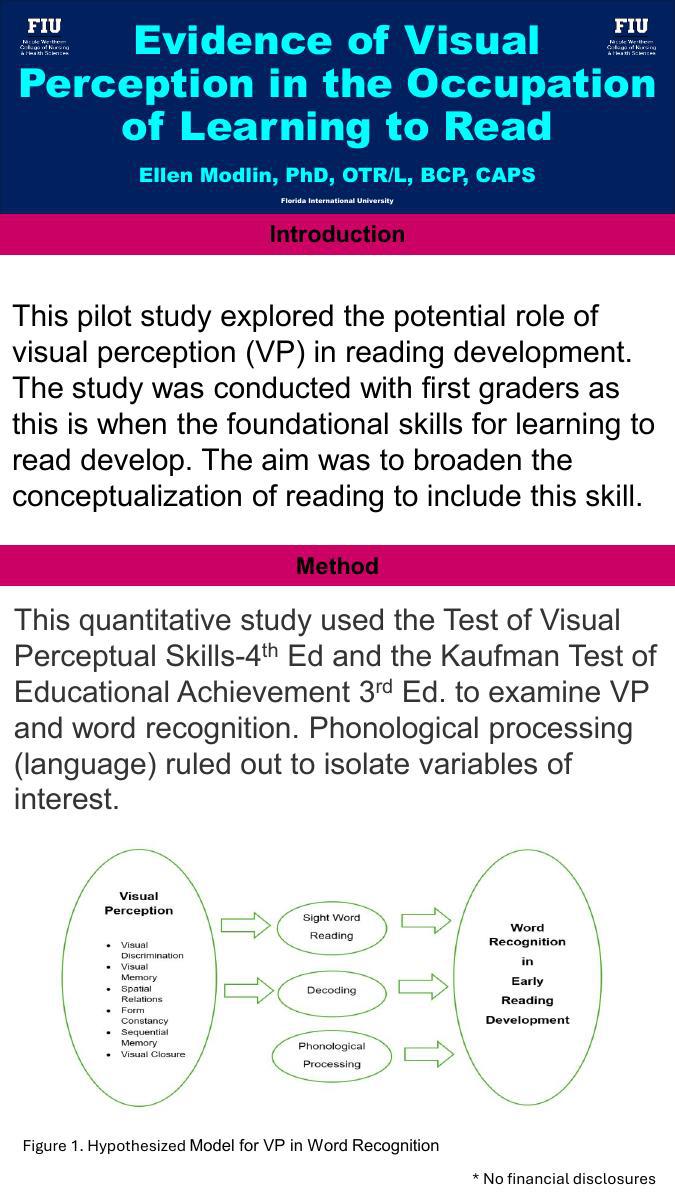
Introduction: Learning to read is an essential occupation of students; however, only one-third of U.S. fourth-grade public school students read proficiently. Current language-based reading instruction appears imperfect. It is hypothesized that visual perception (VP) is a critical performance skill of early reading development.
Objectives: Learn how learning to read falls within the occupational therapy scope of practice. Learn about VP as a performance skill involved in the occupation of learning to read.
Methods: This quantitative study utilized a predictive design to explore the relationships between VP and word recognition skills in first grade students participating in general education. Eighty students were tested using the Test of Visual Perceptual Skills-4th Ed. And the Kaufman Test of Educational Achievement. This sample size was dictated by a power analysis. Composite and subtest scores were analyzed to identify significant relationships.
Results: VP predicts word recognition (F(7,72) = 2.16, p < .05, R2 = .17, R2 adjusted = .09). Visual memory subskill has a statistically significant relationship with word recognition (B = .43, t = 3.4, p < .05)
Conclusion: Learning to read is an occupation of students, yet occupational therapists are rarely consulted when children struggle. A change in approach is warranted. This study highlights the role of VP in word recognition. Occupational therapists understand the impact of VP on function and should should support students who struggle with learning to read and do not respond to traditional reading instruction.