
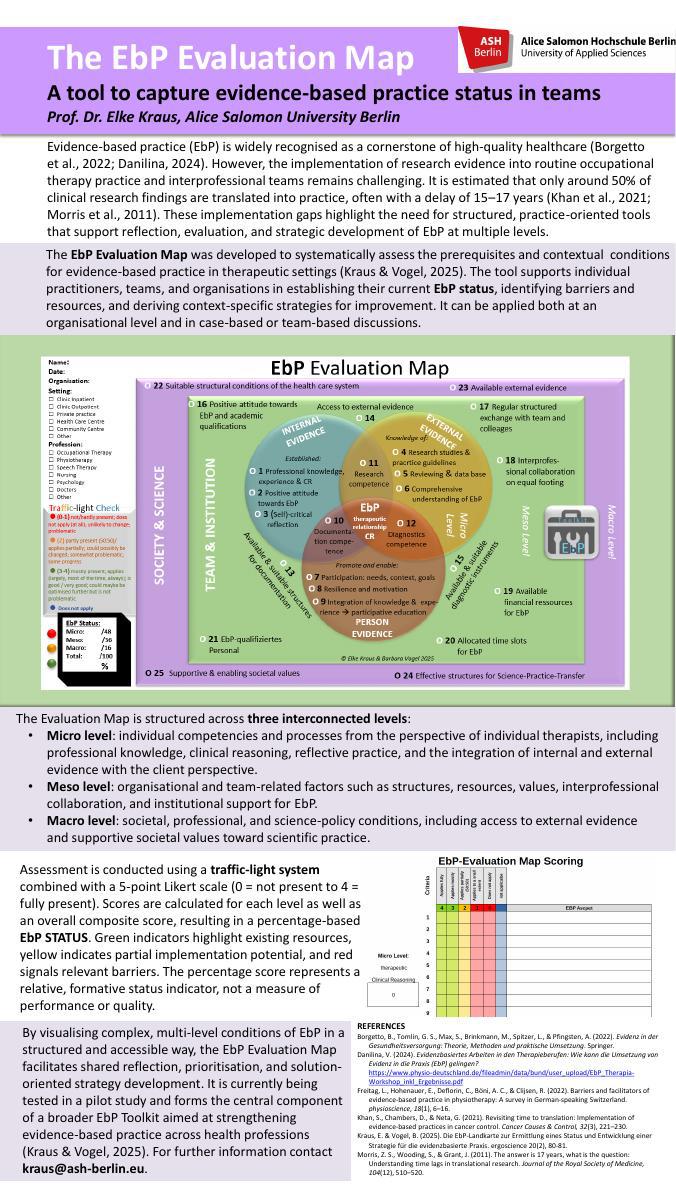
Introduction & Rationale: Globally, Evidence-based practice (EbP) is a requirement of current occupational therapy practice, ensuring high-quality future-orientated healthcare. However, its implementation is often not very successful. Why? To assess each work situation uniquely, an EbP-Map was developed to systematically reflect and evaluate the prerequisites and conditions needed for effective EbP- practice.
Objectives and Method: The EbP-Map supports therapists, their team and institution to analyse and better understand relevant factors affecting EbP at different levels, and to then discover solutions to overcome the obstacles collaboratively. Therapists in different settings were introduced to apply the tool and subsequently participated in a survey and/or focus groups.
Results: Participants rated the EbP-Map as a useful tool to develop evidence-based practice. Results from the focus groups and survey resulted in optimising and specifying the EbP-Map (see poster).
Practice Implications: The EbP-Map guides individuals and teams in occupational therapy through relevant and important criteria that enable effective evidence-based practice. There are three steps: (i) mapping the individual and team EbP-Status using the Traffic-Light-Check; (ii) identifying and prioritising potential changes; and (iii) collaboratively finding solutions and strategies to existing obstacles.
Contribution to the Occupational Therapy Profession: In the context of increasing demands to prove the effectiveness of therapeutic practice on the one hand, and ensuring a high quality, evidence-informed and scientifically founded therapy on the other, EbP remains a strong indicator for best-practice occupational therapy. The EbP-Map is a practice-friendly collaborative tool to help improve the EbP-Status individually and within a team.