
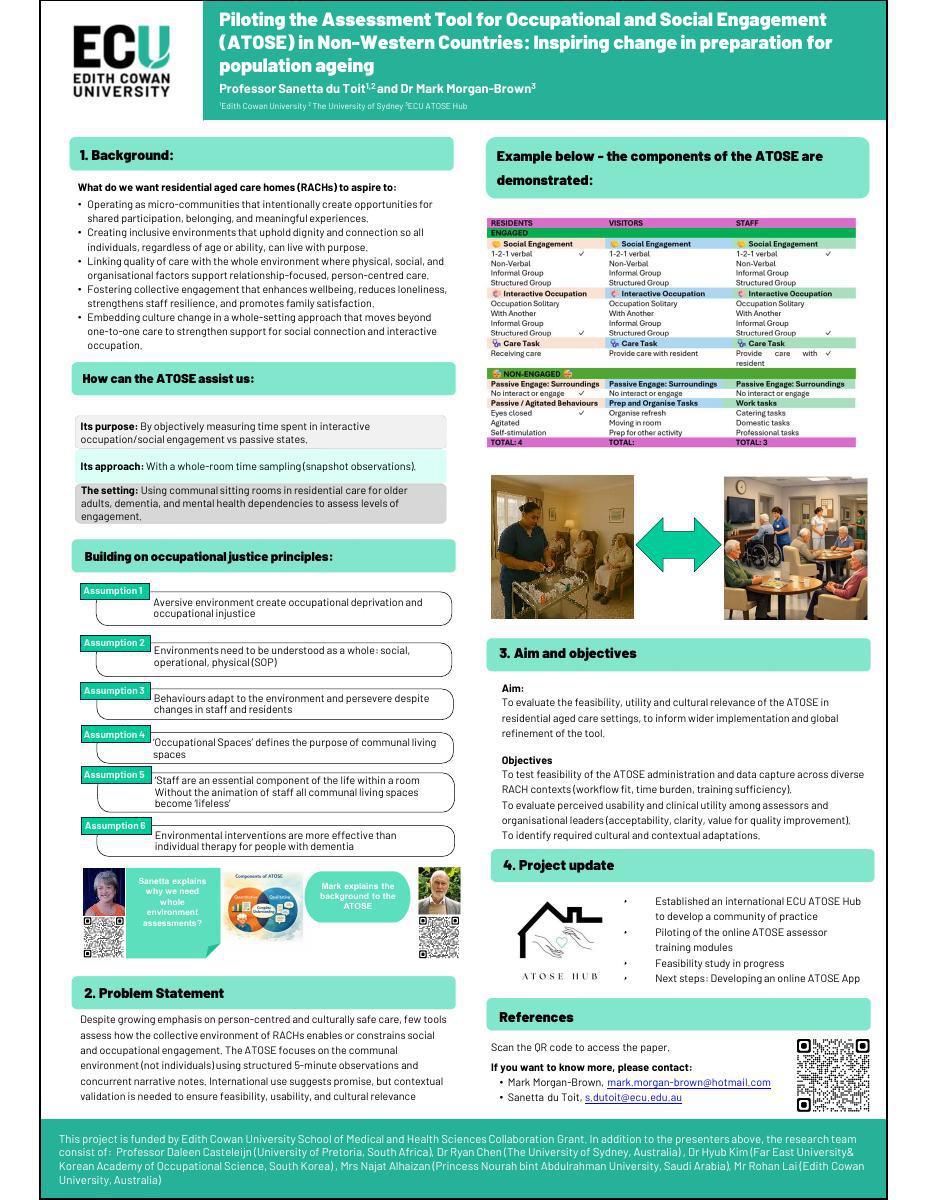
Introduction: The Assessment Tool for Occupational and Social Engagement (ATOSE) is an objective, direct observational tool which systematically measures engagement within residential care communal spaces and thereby supports and promotes person-centred care (PCC) practices. The ATOSE's potential for global application becomes particularly significant when considering the diverse landscape of residential care across different cultural contexts. While PCC principles advocate for individual autonomy and holistic wellbeing, these principles are mainly based on research and practice within western countries. Limited exploration of research on PCC in non-western countries leads to uncertainty over whether and how current PCC understandings apply to residential care settings with diverse cultures.
Objective: To pilot the acceptability and cultural applicability of the ATOSE in capturing PCC principles across diverse cultural contexts in South Korea, Saudi Arabia and Singapore.
Methods: This quantitative investigation will be supported by a mixed-methods approach, with a pre-post intervention attitude survey, The Fraboni Scale of Ageism (FSA) and focus groups (to explore if and how the opportunity to learn about and practice implementing the ATOSE assisted with an understanding of delivering person-centred care).
Results: Anticipated results will 1) assess the tool’s ability to identify and measure occupational participation and social engagement across different cultural contexts; 2) examine the alignment between ATOSE observations and specific cultural understandings of person-centred care; 3) identify potential modifications or adaptations necessary to make the ATOSE more culturally sensitive and universally applicable.
Conclusion: Using the ATOSE, occupational therapists will measure and appraise the occupational participation and social engagement of residential care settings in different cultural contexts to promote PCC principles in practice.