
Rationale: Understanding the collective and temporally-situated dimensions of occupation is critical to enabling equitable access to occupational justice in and between diverse communities.
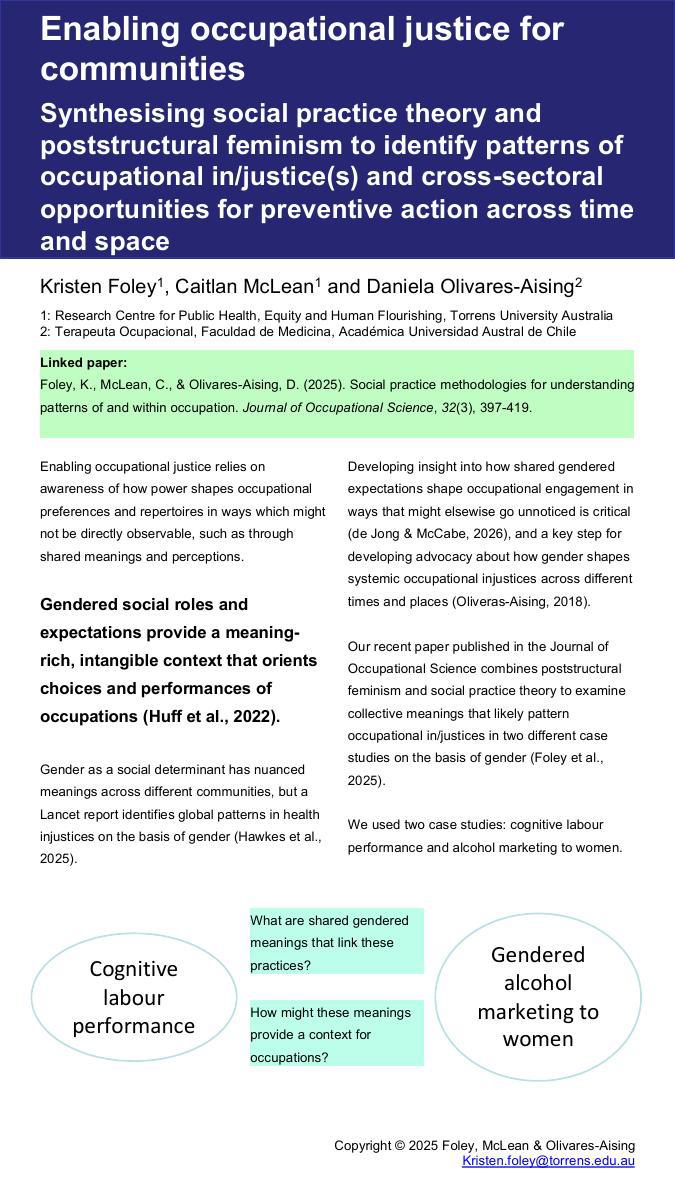
Objectives: We synthesise poststructural feminism and social practice theory to enable analysis of collective dimensions of occupational in/justice that are linked over time and space.
Approach: We identify examples of gendered occupational injustice(s). We show, using worked examples, how social practice theory can be used to identify barriers to justice at levels of shared meanings, materials, and competences. We apply poststructural feminist philosophy to deepen and elucidate the tensions and transactions in which (collective) occupational engagements are situated, that are re/produced in/through occupational entanglements of different moments, places, and people.
Practice Implications: Our work opens new opportunities to articulate how the histories and futures of occupational injustices are influential to doing, being, becoming and belonging through occupation. We use our case study to illuminate multiple points of action for better enabling occupational justice in the present. We further showcase how thinking about patterns of occupational engagement is useful to identify potential occupational injustice(s): in ways which prompt collaborative cross-disciplinary, cross-sectoral, and political advocacy to strategically prevent occupational injustice.
Conclusion: Elucidating the sociohistorical positionings and collective performativities of practice, rather than only individuals or occupations, enables a more embedded and situated view of occupational injustice(s). These comprehensive and politically-engaged approaches are critical for occupational therapists who wish to work with communities and populations to realise more equitable and just futures.