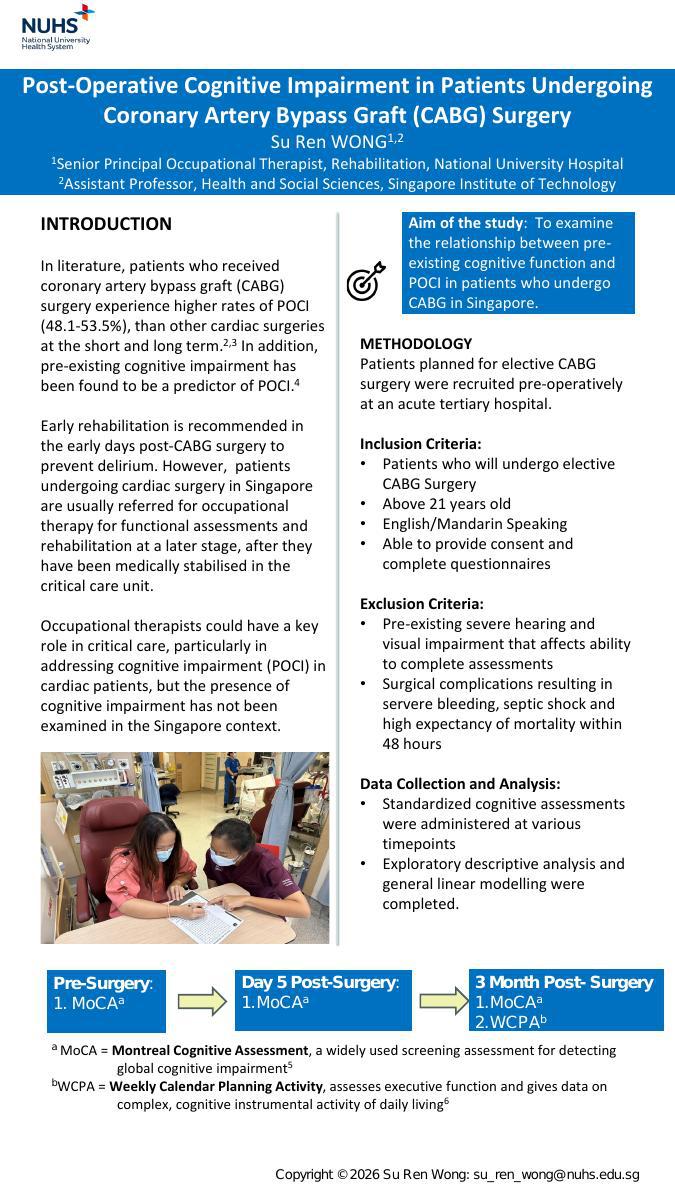
Introduction / Rationale: Occupational therapists could have a key role in addressing post-operative cognitive impairment (POCI) in patients with cardiac surgeries, but are often underutilized in critical care. In literature, patients who received coronary artery bypass graft (CABG) surgery experience higher rates of POCI (48.1-53.5%), than other cardiac surgeries. In literature, pre-existing cognitive impairment has been found to be a predictor of POCI, but this has not been examined in the Singapore context. Objectives: The aim of this study is to examine the relationship between pre-existing cognitive function and POCI in patients who undergo CABG in Singapore. Methods / Approach: Patients planned for elective CABG surgery were recruited pre-operatively at an acute tertiary hospital. Patients were administered with the Montreal Cognitive Assessment (MOCA) at 3 time points: pre-surgery, 5 days post-surgery and at 3 months post-surgery. Additionally the Weekly Calendar Planning Activity (WCPA) was administered at 3 months post-surgery. Exploratory descriptive analysis and general linear modelling were done. Results / Practice Implications: 102 patients were recruited with a mean age of 61.85 (SD=7.71) years old. Taking into account covariates, MOCA scores at pre-surgery and 5 days post-surgery significantly predicted MOCA scores at 3 months. However, only MOCA at 5 days post-surgery significantly predicted WCPA scores at 3 months. Conclusion / Contribution to the occupational therapy profession: The results support that patients undergoing CABG have long term cognitive impairment, which is predicted by pre-existing and early post-operative cognitive impairment. Occupational therapists could have a vital role in addressing early cognitive dysfunction, and improve long term outcomes.
