
Introduction / Rationale:
Instrumental Activities of Daily Living (IADL) require complex cognitive functions, making their assessment challenging. While performance-based assessments for IADL are limited by safety and environmental factors, virtual reality (VR) offers controlled, risk-free conditions. However, its clinical utility in IADL assessments remains underexplored.
Objectives:
To evaluate the clinical utility of VR-based IADL assessments from the perspectives of patients and occupational therapists (OTs).
Methods / Approach:
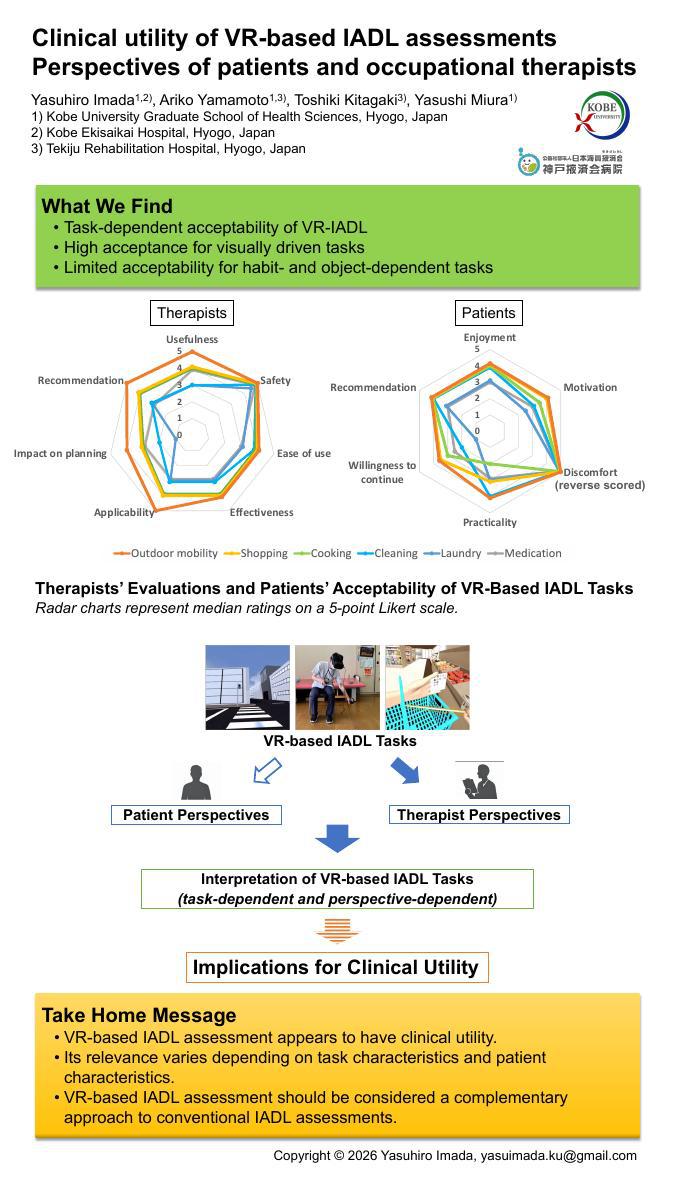
Twelve post-stroke patients (10 males, 2 females) and four OTs participated. Patients completed six VR-based IADL tasks (outdoor mobility, shopping, cleaning, cooking, laundry, medication management) using a VR headset. Both patients and OTs rated the tasks using a five-point Likert scale with additional comments. Patients rated enjoyment, motivation, discomfort, practicality, willingness to continue, and intention to recommend, while OTs rated usefulness, safety, ease of use, effectiveness, applicability, recommendation, and impact on rehabilitation planning. Qualitative data were analyzed thematically.
Results / Practice Implications:
Among the tasks, outdoor mobility received high ratings and was described as realistic and engaging by patients. Cooking also received positive feedback, while cleaning, laundry, and medication management were considered simplistic or unreflective. From the OTs' perspective, all tasks were considered highly safe, and outdoor mobility, shopping, and cooking were regarded as useful and effective. OTs noted VR’s potential, but few of them adopted VR in rehabilitation planning.
Conclusion / Contribution to the occupational therapy profession:
VR-based IADL assessments appear to have clinical utility. However, their appropriateness may vary depending on the specific tasks and patient characteristics. Therefore, OTs should assess their feasibility before clinical implementation. While VR is unlikely to fully replace traditional IADL assessments, it can serve as a valuable supplement.