
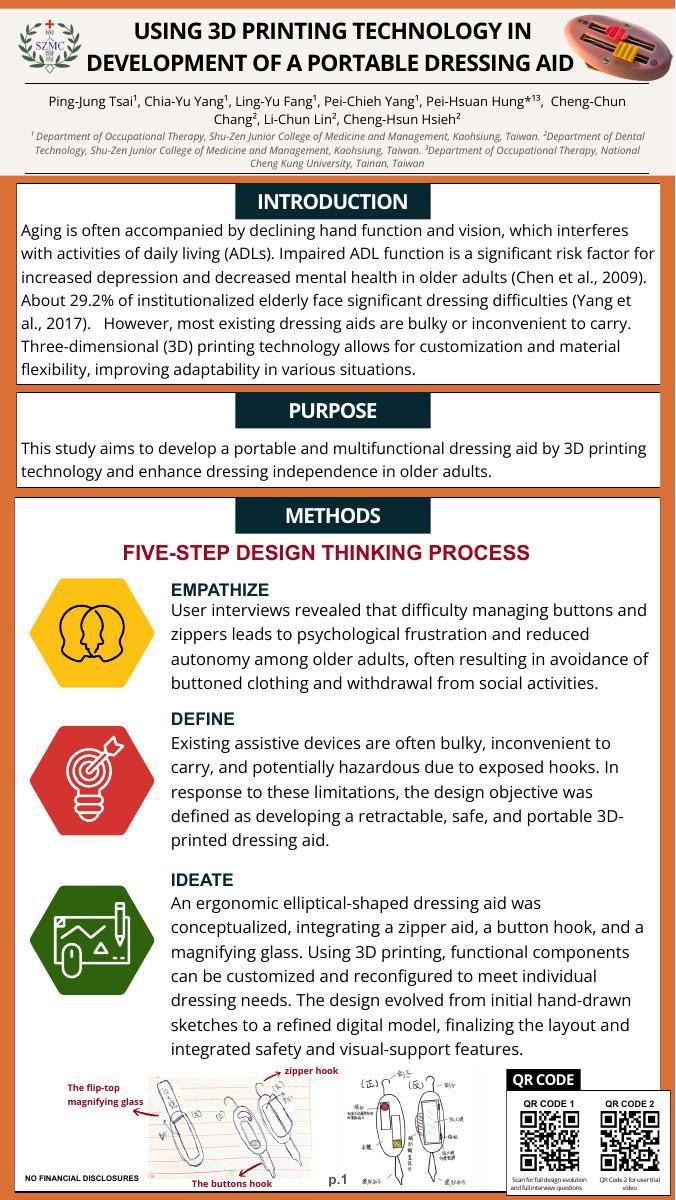
Rationale: Aging often leads to reduced hand function, affecting daily activities like dressing. Many older adults struggle with buttons and zippers due to decreased dexterity and vision, increasing dependence on caregivers. However, most existing dressing aids are bulky or inconvenient to carry. Three-dimensional (3D) printing technology allows for customization and material flexibility, improving adaptability in various situations.
Objective: This study aims to develop a portable and multifunctional dressing aid by 3D printing technology and enhance dressing independence in older adults.
Methods: Following the five-step design thinking process—empathizing, defining, ideating, prototyping, and testing—we design a lightweight, foldable device incorporating a zipper aid, button hook, and magnifying glass. This project involves collaboration between Occupational Therapy Department and teachers from the Materials Technology Department, integrates 3D printing advancements. During the testing phase, 5 elderly users will be interviewed about their usage experience and suggestions. This study is in the prototype stage, with plans to complete the design and conduct user testing by August 2025.
Practical Implications: This 3D printed assistive device is expected to offer more functions than existing dressing aids devices. The dressing aid may improve the elders’ dressing independence both at home and in public settings, and further reducing caregiver burden, and encouraging social participation.
Significance to Occupational Therapy: This study combines 3D printing technology with assistive device design, and enhances functional independence for aging populations. The developing process also explores the interdisciplinary collaboration experience.