
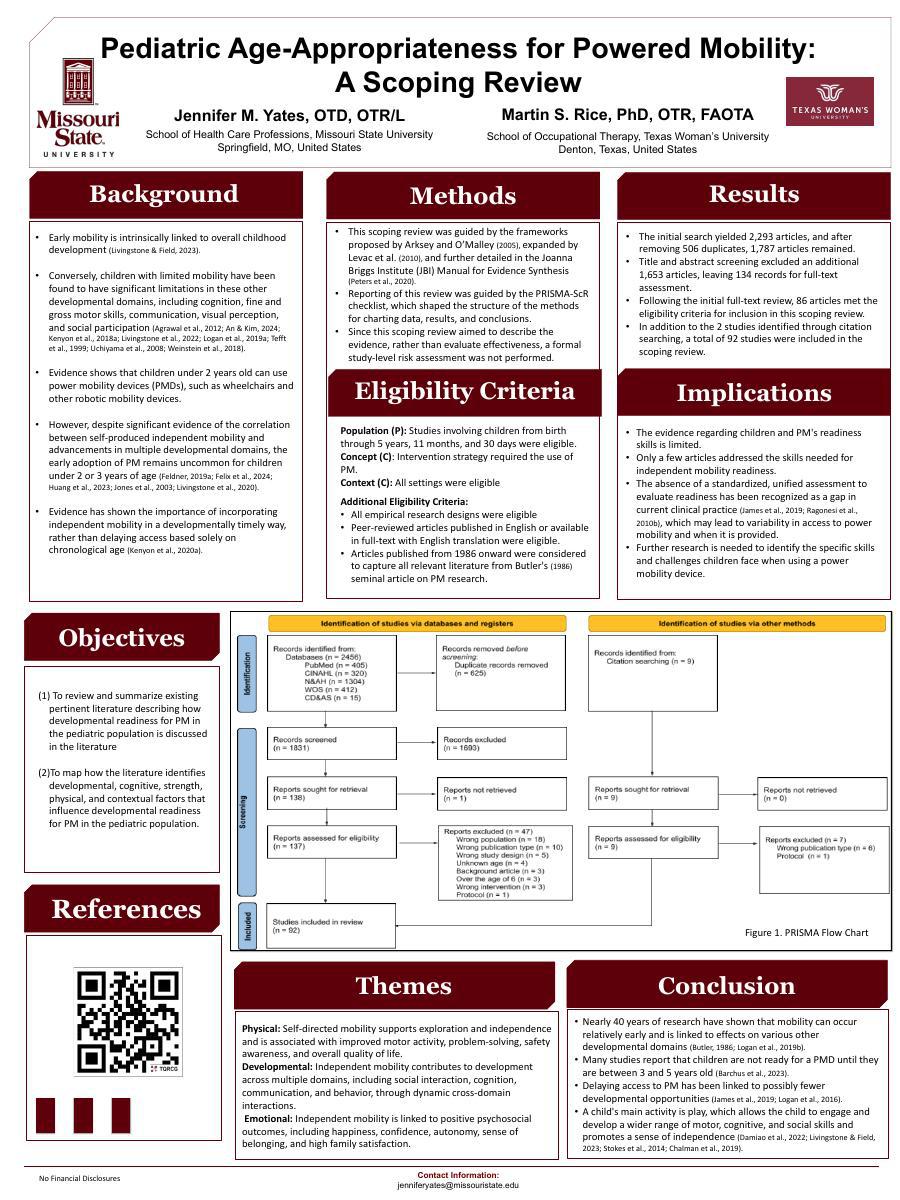
Introduction/Rationale: There is a significant need for clarity regarding the age appropriateness of power mobility for children.
Objectives: This scoping review aims to assess the current research on pediatric power mobility, specifically regarding age appropriateness.
Methods/Approach: The PRISMA-ScR reporting guidelines for scoping reviews were referred to throughout the review process. Articles for this scoping review were retrieved by searching across five prominent databases. Using Rayyan's online scoping review tool, the specific inclusion criteria were applied, and 2293 articles were initially reviewed, narrowing the selection to 93 articles that met the inclusion criteria.
The inclusion criteria for the population were studies involving individuals aged 5 years, 11 months, and 30 days or younger, with interventions focusing on powered mobility, and research designs including quantitative, qualitative, mixed methods, case studies, clinical trials, feasibility studies, comparative and repeated measures studies, descriptive studies, screening tools, observation-based measures, self-report measures, and questionnaires, articles published since 1986 (following a seminal article by C. Butler), and translatable into English.
Results/Practice Implications: Many factors contribute to the “readiness” for power mobility. These factors can include but are not limited to visual perceptual development, cognitive, volitional system, emotional temperance, and musculoskeletal degrees of freedom, including strength, coordination, intact feedback loops, and a reliable effector site.
Conclusion/Contribution to the occupational therapy profession: The review concluded that children can begin using power mobility as early as 7 months, depending on their developmental readiness, provided cognitive functioning is not a limiting factor.
Establishing this clarity through a thorough review of the literature can help create opportunities for children with limited mobility to access and benefit from power mobility devices.