
Introduction
Tele-rehabilitation, the remote delivery of rehabilitation services, is a relatively new approach in Japan with limited available evidence. In regions like Hokkaido, where transportation barriers hinder access to rehabilitation, tele-rehabilitation is being explored as an alternative.
Objective
This case study examines the impact of a tele-rehabilitation program for a stroke survivor with hemiparesis and motor aphasia, aiming to improve physical function and upper limb use.
Methods/Approach
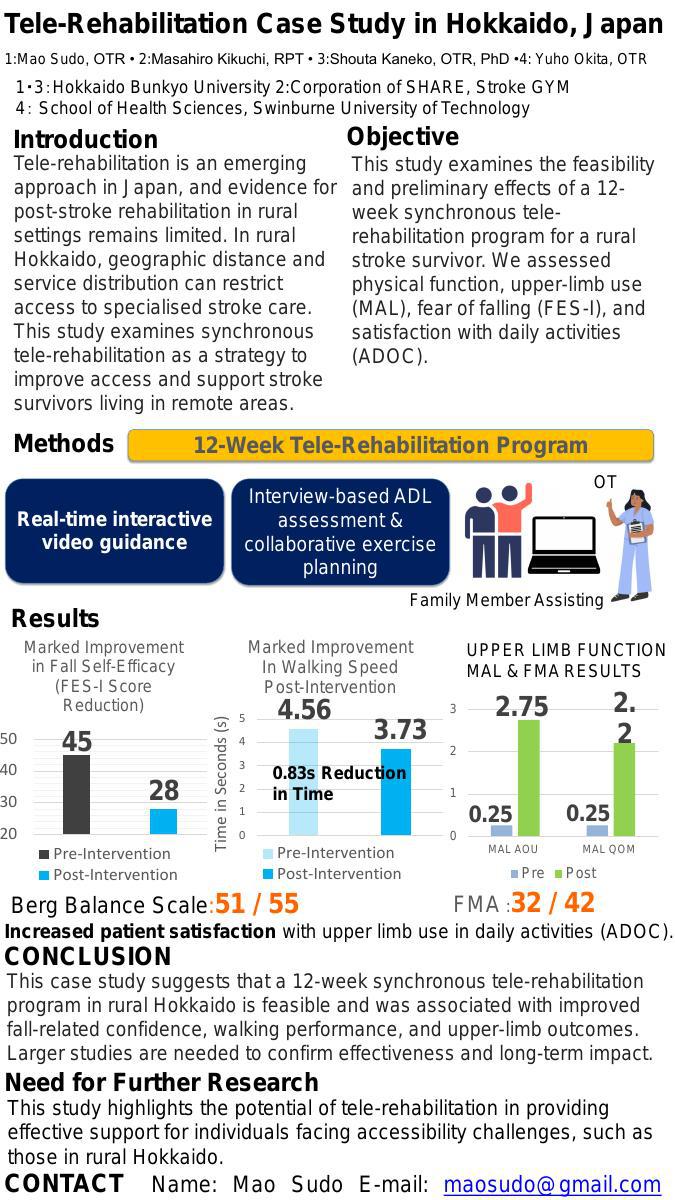
A male stroke survivor in his 40s with hemiplegia participated in a 12-week tele-rehabilitation program, receiving weekly 40-minute remote sessions from an occupational therapist, with a family member assisting. Sessions included: Viewing pre-recorded exercise videos with guided instruction; and assessing daily activity performance, addressing concerns, and discussing strategies. Outcomes were measured pre- and post-intervention using the Fugl-Meyer Assessment (FMA), Motor Activity Log (MAL), Berg Balance Scale (BBS), Falls Efficacy Scale-International (FES-I), 5-meter walk test, and Aid for Decision-making in Occupation Choice (ADOC).
Results/Implications
Improvements were observed in hand function (FMA: 32/42, MAL AOU: 1/11, MAL QOM: 1/9), balance (BBS: 51/55), walking speed (5-meter walk test: 4.56s → 3.73s), self-efficacy (FES-I: 45 → 28), and satisfaction with upper limb use (ADOC).
Conclusion
This study highlights the potential of tele-rehabilitation in providing support for individuals facing accessibility challenges while achieving multiple positive outcomes for a stroke survivor. Further research is needed to determine whether similar results can be consistently observed in larger populations and to explore the broader potential of tele-rehabilitation.