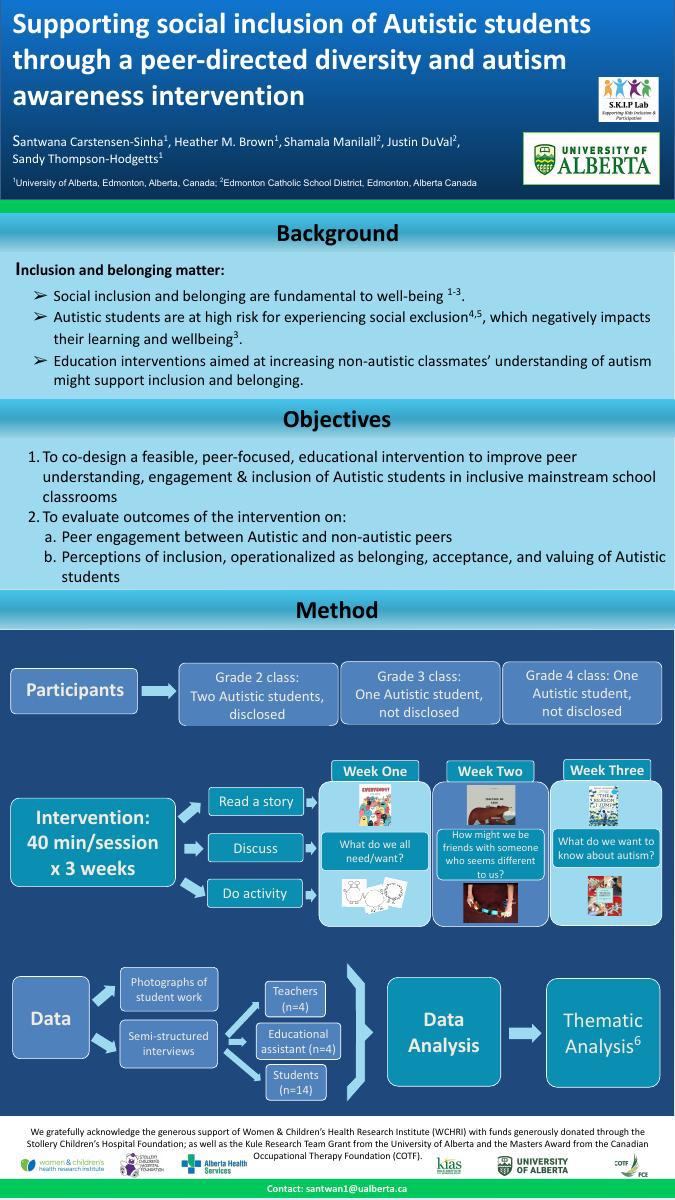
Introduction: Interventions aimed at increasing students’ understanding of autism might support social inclusion for autistic students. Objectives: To co-design and explore perceptions of a student-focused educational intervention on peer understanding, engagement and inclusion of autistic students in inclusive (mainstream) education.
Methods: Three, 40-minute sessions were done in three difference inclusive classrooms (grades 2-4), led by an OT who parents an autistic son. Autistic student(s) in each class was not explicitly identified in the intervention. Each session included a diversity-awareness-themed book, discussion, and creative activity. Data, including pictures of student’s creative work, reflective journals, and interview transcripts (14 students, 3 teachers, 4 educational assistants, 1 consultant) were analyzed through reflexive thematic analysis.
Results: Preliminary themes include: (1) Good citizen vs. good friend reflects shifting mindsets from charity to connection; (2) “That’s just autism” reflects students’ positive reframing of autistic peers; (3) Permission to address the “elephant in the room” reflects students’ appreciation of permission to talk frankly about autism and more fully understanding autistic peers; (4) “I thought it was just me” reflects students’ discoveries of the universality of “feeling different”, leading to new and more authentic social connections across the class, (5) Lived experience as an active ingredient reflects the power of personal stories as an intervention component, and (6) “I could use that” reflects staff’s appreciation of new approaches to use in their classrooms.
Conclusions: A brief, whole-class, diversity- and autism-focused educational intervention supported a shift in attitudes and understanding of non-autistic students towards autistic peers, and towards each other, in an inclusive elementary classroom. The influence of the intervention on social inclusion and belonging for autistic students was less apparent.
