
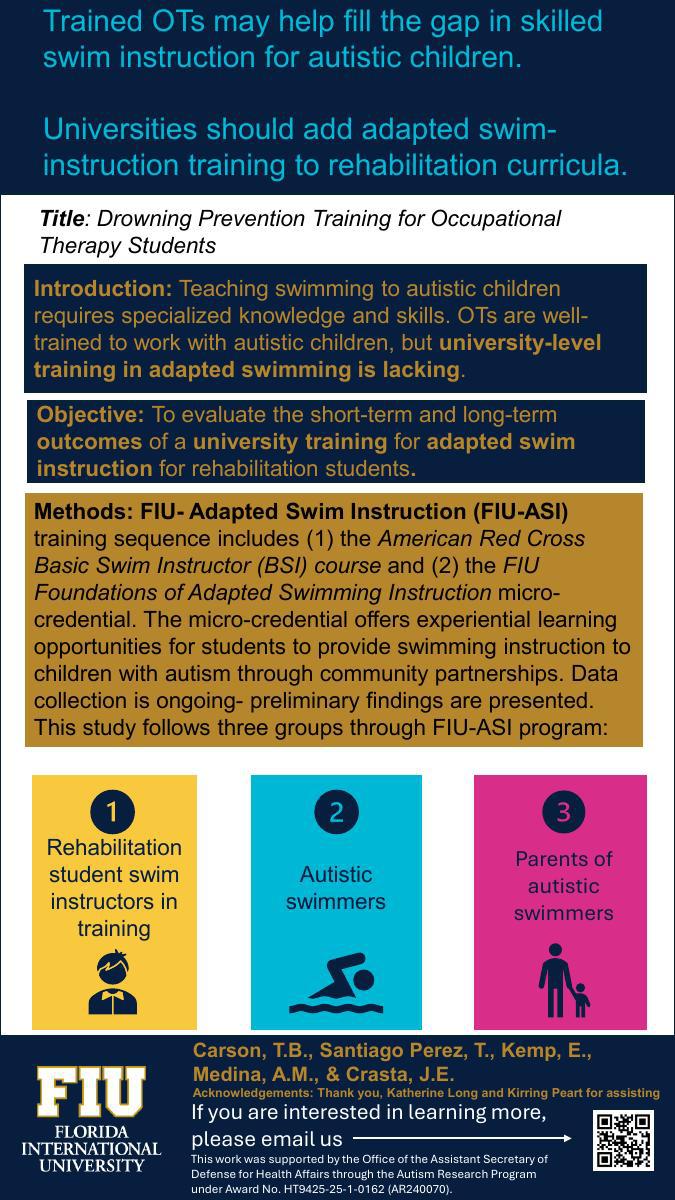
Introduction: Globally, drowning is a leading cause of death for children and children with autism are among those with the highest risk. Drowning is often linked to a lack of water competency. Swimming is a complex motor behavior and teaching swimming to autistic children requires specialized knowledge and skills. Many aquatic professionals report a lack of training on autism, whereas occupational therapists (OTs) do have training in autism and are experts in teaching motor and cognitive skills. While OTs are well suited to fill the gap in access to skilled swim instruction for autistic children university-level training in this area is currently lacking.
Objectives: To evaluate the short-term and long-term outcomes of a university curriculum for swimming instruction training for OT students.
Methods: Using a convergent mixed methods design, and within-subjects repeated measures, quantitative and qualitative data is being collected to evaluate learning outcomes from multiple perspectives: students, autistic swimmers, and their parents. Future uptake and utilization of these skills by rehabilitation students is tracked as students graduate and move into practice.
Results: Preliminary data suggests that students are very satisfied with training, their self-efficacy ratings improve, and they are likely to recommend this training to others. Parents of autistic swimmers working with students-in-training are also very satisfied. Data collection is underway, updated data analyses forthcoming.
Contribution: This work provides evidence of learning outcomes for a swim instruction curriculum for higher education rehabilitation programs. These findings lay the groundwork for developing curricula and standards for university-level training to address this critical gap in entry level OT education.