
Introduction: Sasaki (2008) found that interpersonal support tends to cause various emotions, which can worsen mental health. Mizuno (2012) found that, while working together, emotional entanglement between staff members can lead to poor interpersonal relationships, which can lead to poor service quality. Thus, although the importance of emotional labor and sharing has been pointed out, the construct of emotional labor has not been clarified, and the effects of emotional labor and sharing have not been sufficiently verified.
Objectives: In this study, we conducted a questionnaire survey on emotional labor, clarified the construct of emotional labor, and examined the effects of emotional labor and sharing on interprofessional collaboration.
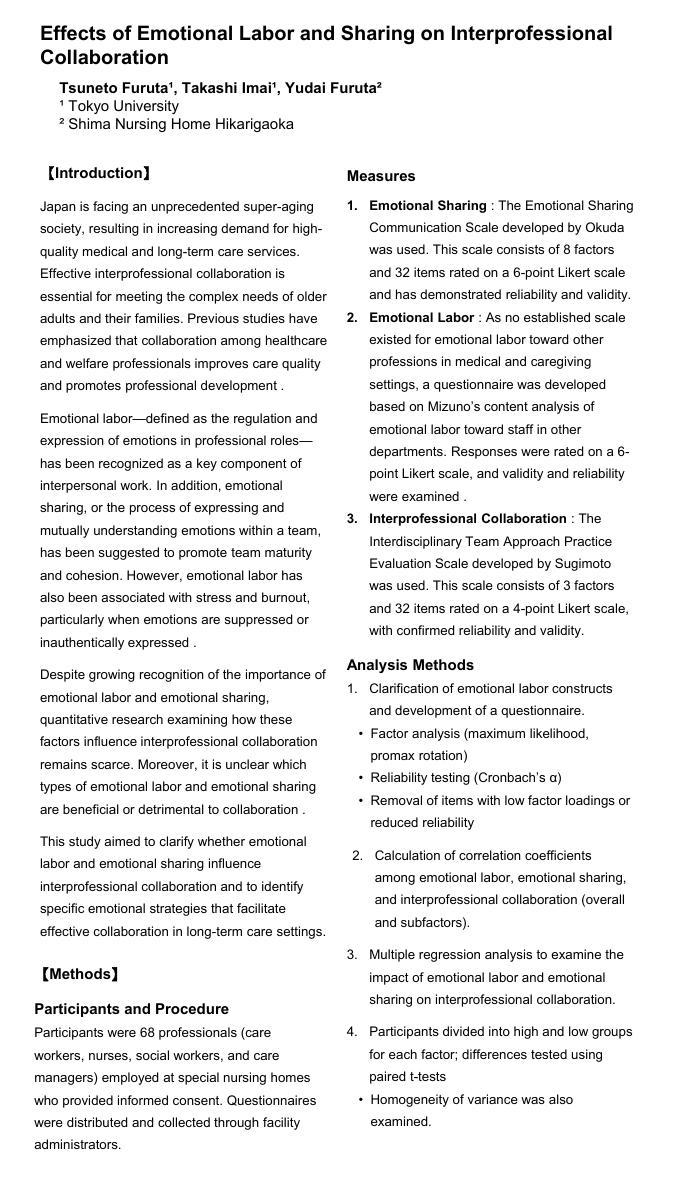
Methods: A questionnaire survey on emotional labor, emotional sharing, and interprofessional collaboration was conducted with 68 staff members working in a special nursing home for the elderly who provided consent for research.
Results: (1) An exploratory factor analysis was conducted, and a questionnaire on emotional labor was created with 4 factors and 14 items. The cumulative contribution rate was 52.1%, and the Cronbach alpha reliability coefficient of each factor was 0.7~0.9. ② Multiple regression analysis showed that cooperation and consideration for the environment had a positive effect on interprofessional collaboration, and patience had a negative effect (p<0.05).
Conclusion: For interprofessional collaboration, it is necessary to express one's feelings including feelings, but it is necessary not to express one's feelings frankly, but to consider the other person's feelings and the atmosphere of the place and devise ways of expressing them.