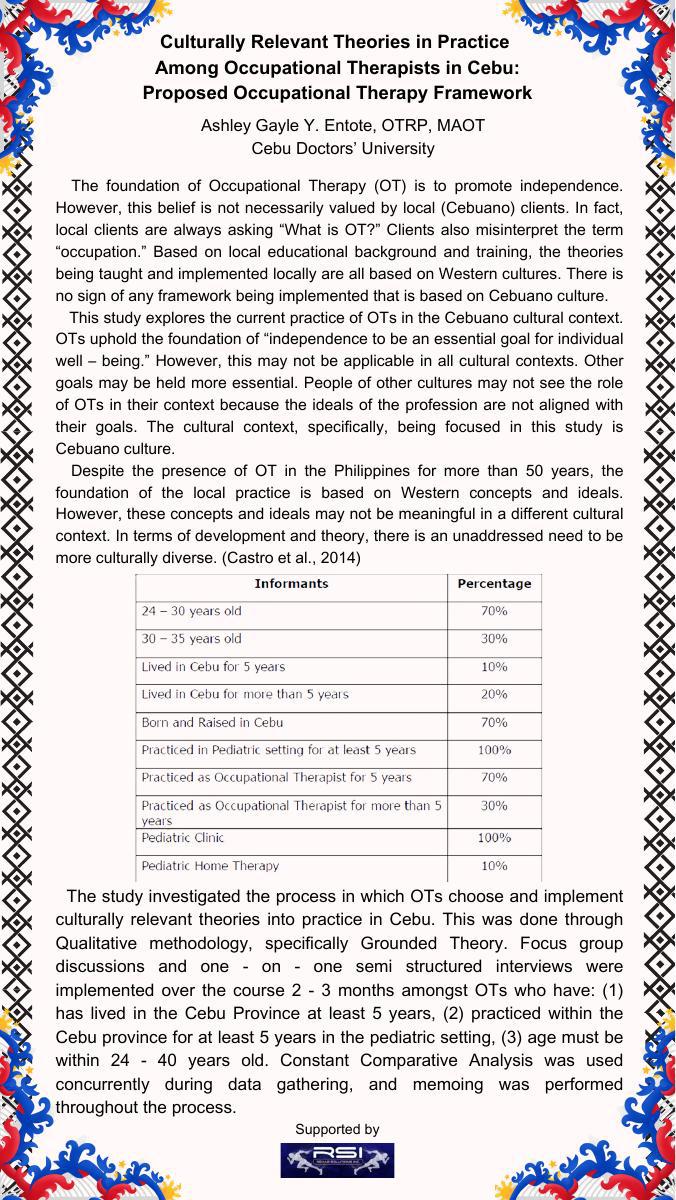
Introduction / Rationale: There is no sign of any framework being implemented that is based on Cebuano culture. There is a need to explore the existing practice of OTs in Cebu to identify the cultural factors that affect the application of Western theory to non Western practice. This is to bridge the gap between OTs and Cebuano clients.
Objectives: The study aims to explore the process in which Occupational Therapists in Cebu choose and apply culturally relevant theories in their practice, and to propose an Occupational Therapy framework for the Cebuano setting.
Methods / Approach: The method used was Grounded Theory. A total of 9 informants joined the study via online focus group discussions and one – on – one semi-structured interviews.
Results / Practice Implications: The OTs in Cebu use the OT process from the American OTPF to choose and apply culturally relevant theories in their practice. The theory found was “The Holistic Interactive Theory of Cebuano Pediatric Occupational Therapy.” This theory defined the process that occurs in the pediatric practice within Cebu. “The Dual Interaction and Communication Framework For Cebuano Pediatric Occupational Therapy” is the proposed OT framework. To match this, the tool called “Occupational Therapy Communication Form: Cebuano Pediatric Setting” was formulated to accompany the framework.
Conclusion / Contribution to the occupational therapy profession: The process in which OTs in Cebu choose and apply culturally relevant theories is based on the Western originating framework that is the American OTPF. There are specific Cebuano cultural factors that need to be considered that affect the process in which they implement theory into practice.
