
Introduction / Rationale
Case managers have long held a vital role in assisting with the discharge planning process in hospital settings. Through their own clinical reasoning and process, they assess and provide targeted interventions to patients throughout their hospital stay. As occupational therapy (OT) practitioners are uniquely trained to assess and address the daily functional challenges individuals face, they can serve a unique and imperative role in assisting case managers with the discharge planning process, especially for patients who have been historically marginalized or who have additional needs.
Objectives
Describe the key responsibilities and functions of a case manager in a hospital setting.
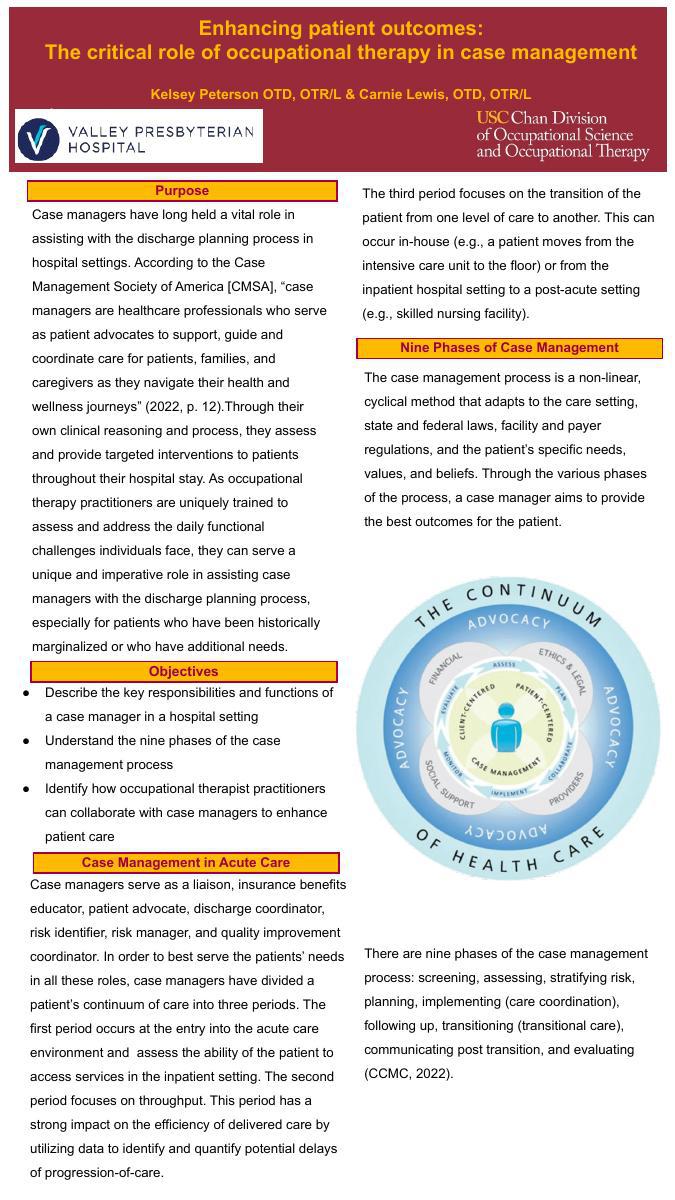
Understand the nine phases of the case management process.
Identify how occupational therapist practitioners can collaborate with case managers to enhance patient care.
Methods / Approach
This poster describes the role and clinical reasoning of case managers in a hospital setting with emphasis on how OT practitioners can effectively provide valuable insight within each of the nine phases of the case manager process.
Results / Practice Implications
OT practitioners' holistic and intersectional lens provides a foundation to inform case managers and subsequently support successful patient outcomes. This can be accomplished through recommendations for durable medical equipment, community support networks, financial support opportunities (e.g., GoFundMe), and post acute care rehabilitation.
Conclusion / Contribution to the Occupational Therapy profession
By understanding case managers' role and process in the acute hospital setting, OT practitioners can better meet the increasing needs of patients from marginalized communities, uninsured patients, and those requiring additional support through effective collaboration and support of the case management process.