
Introduction: Mental health issues among workers are a growing concern, with the World Health Organization (2022) advocating for workplace interventions. Identifying risk factors for Occupational Dysfunction (OD) is essential for sustainable employment, yet the impact of job content on OD remains underexplored.
Objective: This study compares OD risk among workers by occupation and age, clarifying the factors contributing to high-risk conditions.
Methods: An online survey was conducted with a total of 535 participants, including employed individuals aged 20–60 and students. Participants were categorized into seven occupational groups: "Managers," "White-collar workers," "Interpersonal service workers," "Solo workers," "Students," "Heavy labor workers," and "Others." OD was assessed using the standardized questionnaire of the Classification and Assessment of Occupational Dysfunction (CAOD; Teraoka & Kyougoku, 2015). The CAOD classifies OD into four types: Occupational Imbalance, Occupational Deprivation, Occupational Alienation, and Occupational Marginalization. Participants gave informed consent to use their anonymized data. Statistical analysis included Kruskal-Wallis tests with multiple comparisons to examine OD severity by occupation and age group.
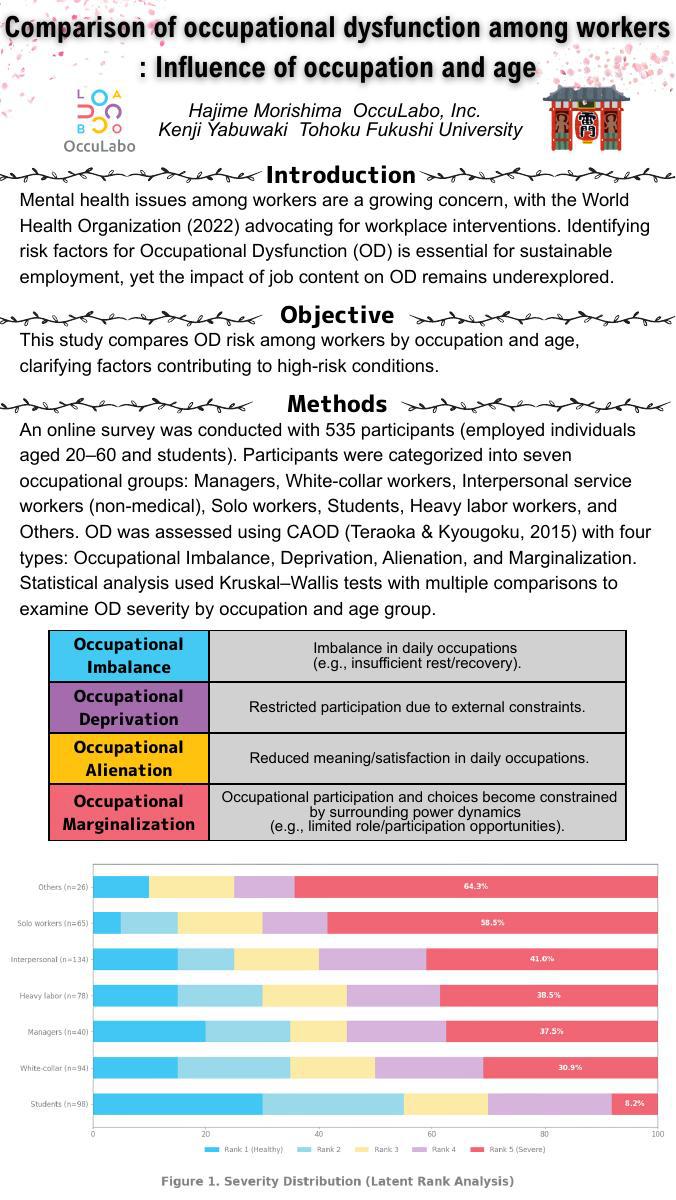
Results: According to the CAOD, 364 (68.0%) participants were classified as having OD. By occupational group, significant differences were observed in total OD score (p = .000, η² = .104), Occupational Deprivation (p = .000, η² = .113), Occupational Alienation (p = .000, η² = .051), and Occupational Marginalization (p = .000, η² = .123). Multiple comparisons revealed the greatest difference in Occupational Marginalization between "Solo workers" and "Students" (p = .000, r = .312).
Conclusion: This study demonstrated that OD risk varies by occupation and is more severe than among students. These findings underscore the necessity of occupation-specific support to promote well-being among workers.