
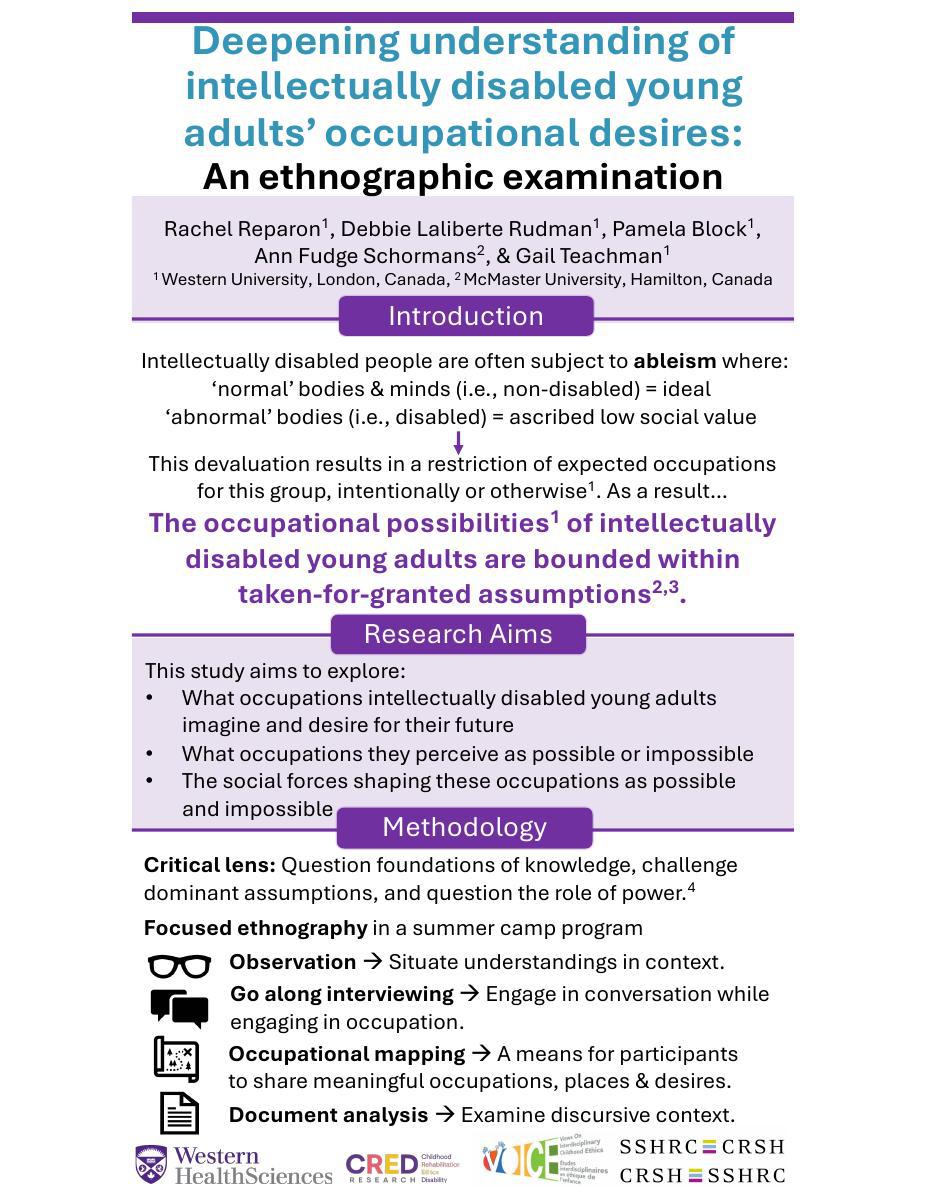
Introduction: Intellectually disabled people are often subject to ableism where ‘normal’ (i.e., non-disabled) bodies are the taken-for-granted ideal and ‘abnormal’ (i.e., disabled) bodies are ascribed low social value, resulting in marginalization. One effect of this devaluation is the tendency to restrict (intentionally or otherwise) occupations that are socially expected for this group. Consequently, their occupational possibilities are limited. Countering such oppression requires situating intellectually disabled people as capable and knowledgeable, creating space to explore their occupational desires.
Objectives: This presentation considers how occupational possibilities shape the lives of intellectually disabled persons, prompting reflection on how occupational therapy can promote expansion of those possibilities.
Approach: We utilized a critical ethnographic approach, informed by critical disability studies and occupational science, to co-produce rich data through observation, occupational mapping, and go-along interviewing with eight intellectually disabled young adults attending a summer program. Participants engaged in a process of co-analysis using a series of occupation-based dialogues to ensure their views were consequential in shaping the results.
Results: Our analysis illuminates the ways that social forces and dominant assumptions shape the occupations intellectually disabled young adults see as possible and desirable for themselves. The results surface troubling tensions and dissonance between the occupational expectations placed upon intellectually disabled young adults and their desires for occupations assumed to be out of bounds for them (e.g., intimacy, parenting, partying).
Conclusion/Significance: Our results can inform research and practices that acknowledge the inherent value of all people and help expand beyond socially-imposed limitations placed on ways of being and doing for intellectually disabled people.